How AI Investment Is Propping Up Global Growth Heading Into 2027
ALT: AI investment driving global economic growth trends heading into 2027 market outlook
For educational purposes only. Not investment advice.
- AI capital expenditure — particularly the massive infrastructure build-out of data centers, chips, and power systems — is currently acting as a meaningful stabilizer for global GDP growth at a moment when traditional drivers like consumer spending and trade are running unevenly.
- The benefits of AI-led growth are concentrated: they flow most directly to technology, construction, and energy sectors in a small number of countries, and they do not yet translate into broad wage growth or improved economic conditions for middle- and lower-income workers.
- The sustainability risk is real. The AI investment cycle is sensitive to revenue expectations, energy constraints, and regulatory environments. A repricing of those expectations could cause a faster-than-usual slowdown in this growth engine.
- Traditional economic drivers — consumer spending, trade, and manufacturing — remain the foundation of most households' economic experience, and their current softness explains why many people feel the economy is weaker than the headline numbers suggest.
- The most informed way to read economic headlines through 2027 is to distinguish between aggregate GDP data, which captures AI investment, and the distributional picture, which reflects whether that growth is reaching everyday workers and households.
- If you want to keep interpreting financial and economic headlines with this kind of clarity, the next step is to find a source that consistently translates aggregate data into plain-English context — without the spin.
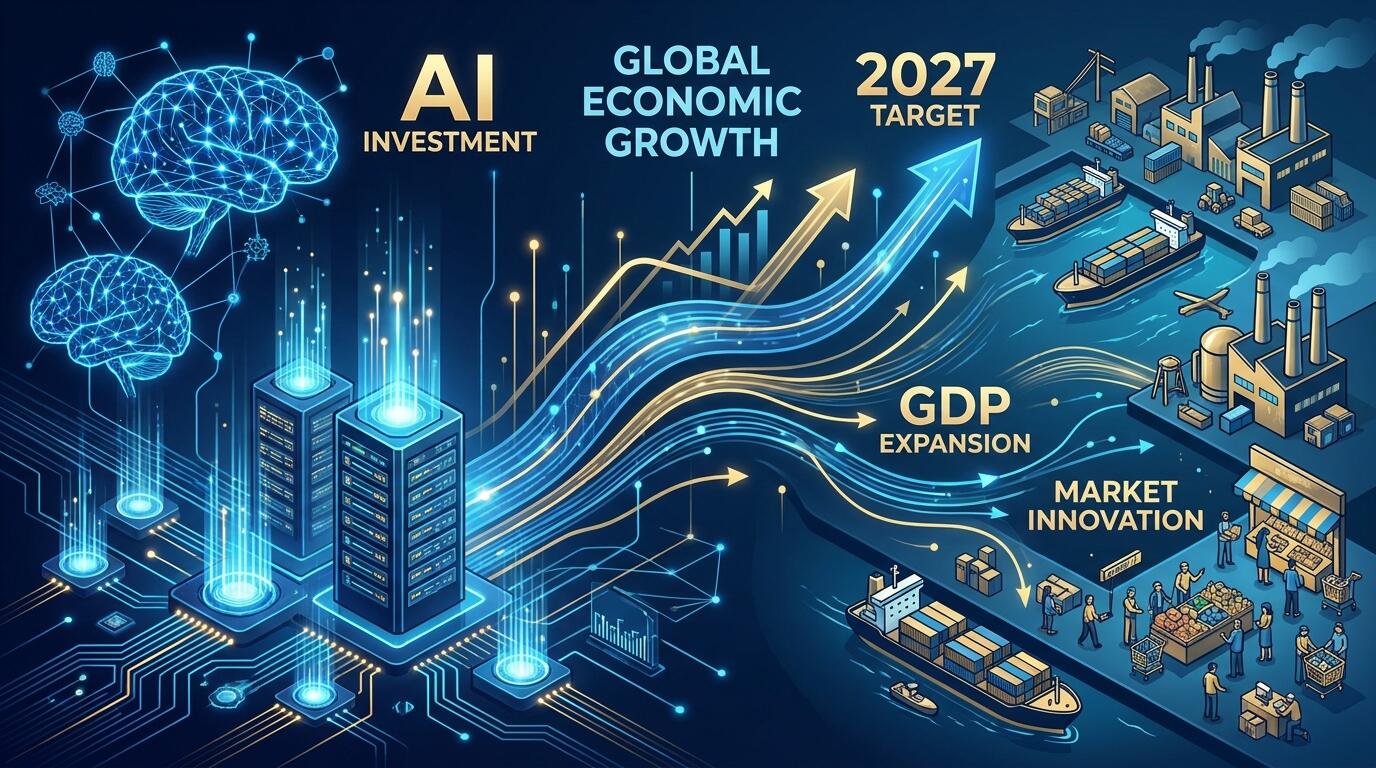
ALT: AI investment driving global economic growth trends heading into 2027 market outlook
AI Investment vs. Traditional Economic Engines: Which Is Really Driving Global Growth Toward 2027?
The single question on economists' and everyday readers' minds right now is this: is the surge in AI spending genuinely holding up the global economy, or is it a fragile bet that could unravel before 2027? The direct answer is that AI investment has become one of the most significant structural forces sustaining global GDP growth at a moment when other traditional engines — consumer spending, trade volumes, and manufacturing output — are firing unevenly. This article compares AI-driven growth against the traditional pillars of economic expansion, examines what's actually happening beneath the headlines, and flags the real risks that rarely get explained in plain English.
The comparison here is between two broad economic narratives: one in which AI capital expenditure and the infrastructure boom surrounding it act as the primary growth stabilizer heading into 2027, and another in which traditional demand drivers — consumer spending, export activity, and energy investment — continue to do the heavy lifting. The criteria used to judge each narrative are economic breadth, sustainability, geographic reach, labor market impact, and downside risk. Understanding these dimensions matters because the answer shapes how governments set policy, how businesses plan hiring, and how everyday people interpret the economic environment they're actually living in.
How to Evaluate What's Really Driving Economic Growth Right Now
Economic growth is measured through several lenses that go beyond the headline GDP number. At Vega Brief, a pattern we consistently see is that readers encounter a single statistic — say, "the economy grew by X percent" — with no context explaining where that growth came from or who benefited. Defining the right evaluation criteria is the first step to making sense of competing narratives.
Economic breadth refers to how widely growth is distributed across sectors and geographies. A boom concentrated in a handful of technology companies looks very different from one that lifts manufacturing, services, and agriculture simultaneously. Breadth matters because narrow growth is more vulnerable: if one sector stalls, the whole picture can shift quickly.
Sustainability asks whether the investment cycle underlying growth is self-reinforcing or dependent on conditions that could reverse. Debt-financed capital expenditure, for instance, can produce impressive short-term GDP contributions but create vulnerabilities if interest rates stay elevated or revenue expectations disappoint.
Geographic reach is relevant because "global growth" is not uniform. AI investment is currently concentrated in a small number of countries and metropolitan areas. Whether that concentration broadens before 2027 or remains narrow shapes who actually benefits.
Labor market impact covers whether the spending translates into jobs and wage growth for a broad population, or primarily enriches capital owners and a narrow technical workforce. This is the criterion most directly felt by everyday readers.
Downside risk encompasses the scenarios — regulatory crackdowns, energy constraints, geopolitical disruption, or a sudden repricing of AI expectations — that could cause the investment cycle to decelerate faster than anticipated. Flagging these risks is not alarmism; it is basic economic literacy.
AI Capital Expenditure and Infrastructure Spending as a Growth Engine
AI-driven economic growth is a phenomenon in which large-scale spending on artificial intelligence infrastructure — data centers, semiconductors, power systems, fiber networks, and the specialized software and labor to run them — generates GDP contributions through construction activity, component manufacturing, energy demand, and the downstream productivity gains that follow deployment. According to reporting tracked by Cryptonomist, major technology companies are collectively on a trajectory toward one trillion dollars in AI-related capital expenditure by 2027, a figure that represents an extraordinary concentration of private investment flowing into a single technology wave. This spending does not stay inside the technology sector: it ripples outward into commercial real estate, utilities, engineering services, and even local labor markets near new data center sites.
The mechanism through which AI investment props up global growth is relatively straightforward. When a hyperscaler (the industry term for a very large cloud computing provider) commits tens of billions of dollars to build data centers, that commitment triggers contracts for construction firms, electrical equipment manufacturers, cooling system suppliers, and specialized chip producers. Each of those contracts, in turn, generates employment and purchasing activity in their own supply chains. Economists call this the "multiplier effect," and it is the same logic that makes large infrastructure programs — highways, ports, power grids — historically significant for GDP.
What distinguishes the current AI investment cycle is its speed and concentration. Analysts and commentators tracking the AI 2027 scenario have noted that the pace of commitment is unusually rapid, meaning the economic stimulus effect is front-loaded rather than spread evenly over many years. That front-loading is both a strength (growth support now) and a vulnerability (a sharper cliff if spending plateaus).
Traditional Economic Drivers: Consumer Spending, Trade, and Manufacturing
Traditional economic growth drivers are the forces that powered global GDP for most of the post-World War II era: rising consumer spending fueled by wage growth and credit availability, expanding international trade, and industrial manufacturing activity. These forces remain enormous in absolute terms and still account for the majority of economic activity in most countries. The question is not whether they exist but whether they are accelerating, holding steady, or softening at a moment when policymakers need growth to absorb elevated debt levels and still-sticky inflation in many economies.
Consumer spending, the largest single component of GDP in developed economies, has been under pressure from higher borrowing costs following the interest rate increases of the early 2020s. Trade flows have been disrupted by geopolitical tensions, supply chain restructuring, and the early effects of tariff policy changes. Manufacturing, while recovering in some regions, has not returned to the pre-pandemic expansion pace across the board. In this environment — where traditional engines are running at reduced power — the AI investment surge has taken on an outsized stabilizing role, even if most households do not directly experience its effects.
ALT: Comparison of AI infrastructure spending versus traditional economic growth drivers heading into 2027 global markets
Head-to-Head: AI Investment vs. Traditional Drivers Across Key Criteria
Criterion — AI-Led Investment — Traditional Drivers (Consumer, Trade, Manufacturing)
Economic Breadth — Narrow — concentrated in tech, energy, and construction sectors near data center hubs — Broad — distributed across nearly all industries and income levels
Sustainability — Dependent on continued revenue expectations; high debt-financed capex risk — More cyclical but historically self-correcting over longer periods
Geographic Reach — Primarily U.S., parts of Europe, and select Asian markets; limited in emerging economies — Inherently global, though unevenly distributed
Labor Market Impact — High-skill, high-wage job creation; limited direct benefit for middle- and lower-income workers — Broader employment base, including blue-collar and service-sector workers
Downside Risk — Concentrated — a repricing of AI expectations, energy constraints, or regulation could decelerate rapidly — Distributed — no single shock typically collapses all traditional drivers at once
Current Momentum — Accelerating heading into 2027 — Softening in developed economies; mixed in emerging markets
The table above reveals a nuanced picture that neither cheerleaders nor skeptics of AI investment fully capture. AI-led investment is genuinely contributing to global growth stability at a critical juncture, but it is doing so in a concentrated, sector-specific way that does not equally lift all boats.
The most important interpretation from this comparison is that AI investment and traditional growth drivers are not really in competition — they are running in parallel, with AI currently punching above its weight in terms of GDP contribution relative to the share of the workforce it directly employs. This creates a structural divergence: the macroeconomic headline numbers look more resilient than the lived experience of many middle-income households would suggest. In our work at Vega Brief explaining financial news to everyday readers, this gap between aggregate data and personal experience is one of the most consistent sources of confusion we see.
The downside risk column deserves particular attention. Traditional economic engines distribute risk broadly — a slowdown in one country's consumer spending does not automatically collapse manufacturing in another. AI investment, by contrast, is concentrated enough that a significant shift in expectations — whether driven by a major regulatory development, a disappointing earnings cycle from technology firms, or an energy grid constraint that limits data center expansion — could cause a meaningful and relatively rapid deceleration. The Bayesian Investor's analysis of AI 2027 scenarios has noted the importance of distinguishing between what is technically possible and what economic and infrastructure constraints make likely within a specific timeframe.
Which Should You Care About Most? Matching the Narrative to Your Situation
Different readers will relate to these competing economic narratives very differently based on their own circumstances, and understanding which framework is most relevant to you is the practical payoff of this comparison.
If you work in technology, construction, energy, or professional services near major metropolitan areas, the AI investment boom is likely already affecting your job market and may continue to do so through 2027. The demand for data center engineers, power systems specialists, commercial real estate developers, and enterprise software professionals is directly tied to capital expenditure decisions being made right now by large technology companies. The caveat — and it is a significant one — is that this demand is sensitive to the financial performance of those same companies. If AI revenue growth disappoints relative to the infrastructure spending committed, corporate budget cycles can turn quickly.
If you work in retail, hospitality, healthcare, or manufacturing and are trying to understand why economic headlines seem more optimistic than your own experience suggests, the explanation is largely this: aggregate GDP figures capture the AI investment boom, but that boom is not generating broad labor market gains in your sector. Traditional growth drivers in consumer spending and manufacturing are softer, and the benefit of AI infrastructure spending is reaching your sector primarily through second- and third-order supply chain effects rather than direct demand.
If you are a student or early-career professional trying to orient yourself for the next few years, the key insight is that the AI investment wave creates genuine labor market opportunities in technical fields, but the risks are also real. Building adaptable skills — in data literacy, systems thinking, and communication — provides more durable value than specializing narrowly in AI tools that may look very different by 2027.
If you are simply trying to understand whether the economy is as strong as the headlines suggest, the honest answer is: it depends on which economy you mean. At the aggregate level, AI investment is doing meaningful work to sustain growth figures that would otherwise look weaker. But that growth is unevenly distributed, and the sustainability of the AI-led portion depends on conditions — continued private sector confidence, available energy capacity, and stable regulatory environments — that are not guaranteed.
Pros of AI-Led Growth: Generates real economic activity now; drives technological capability; supports employment in high-productivity sectors; stimulates adjacent industries.
Cons of AI-Led Growth: Concentrated benefits; high sensitivity to expectations; energy-intensive and constrained by infrastructure limits; limited direct impact on broad consumer welfare in the near term.
Q1: How does AI investment actually contribute to GDP growth?
AI investment contributes to GDP growth through capital expenditure on data centers, semiconductors, power infrastructure, and software, all of which create economic activity in construction, manufacturing, and services. Each dollar spent on infrastructure typically generates additional spending through supply chain activity — a process economists call the multiplier effect. The International Monetary Fund and similar bodies track capital investment as a direct GDP component, meaning large private sector AI spending shows up in growth statistics even before productivity gains from AI deployment materialize.
Q2: Is the AI-driven economic boom sustainable heading into 2027?
The sustainability of AI-driven growth heading into 2027 depends on whether revenue from AI products and services grows fast enough to justify the scale of capital expenditure being committed. Analysts following the AI 2027 scenario have identified a risk that the infrastructure build-out is running ahead of demonstrated commercial returns — a classic investment cycle risk. If large technology companies begin reporting that AI tools are generating the expected revenue, the cycle is more likely to sustain itself. If revenue disappoints, companies may pull back on capital spending, which would reduce the GDP contribution from this source more quickly than a traditional cyclical slowdown.
Q3: When could the economic impact of AI investment be felt more broadly by everyday workers?
The timeline for AI investment to generate broad labor market benefits is genuinely uncertain and varies significantly by region and sector. Infrastructure build-out phases tend to create jobs in construction and engineering relatively quickly. Productivity gains that lift wages more broadly — through businesses adopting AI tools that make workers more efficient — typically take longer to materialize and depend on how widely affordable AI tools are adopted by small and medium-sized employers, not just large technology companies. Most economic analysis suggests the broader productivity dividend, if it arrives, is more likely to be visible in the second half of the current decade than in the immediate near term.
Sources
Cryptonomist. "Big Tech invest 1 trillion in AI: global race by 2027".
https://en.cryptonomist.ch/2026/05/08/big-tech-invest-1-trillion-in-ai-global-race-for-infrastructure-by-2027/
Bayesian Investor. "AI 2027 Thoughts".
https://bayesianinvestor.com/blog/index.php/2025/04/25/ai-2027-thoughts/
Jannis Moore via LinkedIn. "AI 2027: A bold scenario for AI's future".
https://www.linkedin.com/posts/jannismoore_ai-2027-activity-7322175388309209088-VTV6
International Monetary Fund.
https://www.imf.org/
Note: Economic conditions, investment figures, and policy environments evolve rapidly. Please consult the latest official documents or qualified financial advisors for guidance specific to your situation.
For educational purposes only. Not investment advice. We do not recommend any stock, fund, broker or trading platform. Headlines are sourced from Google News · Business; every story links to the original publishers.