Bank of Canada Watch: What Rising Unemployment Could Mean for Rate Cuts
ALT: Bank of Canada rate cut outlook as rising unemployment signals potential monetary policy easing in Canada
For educational purposes only. Not investment advice.
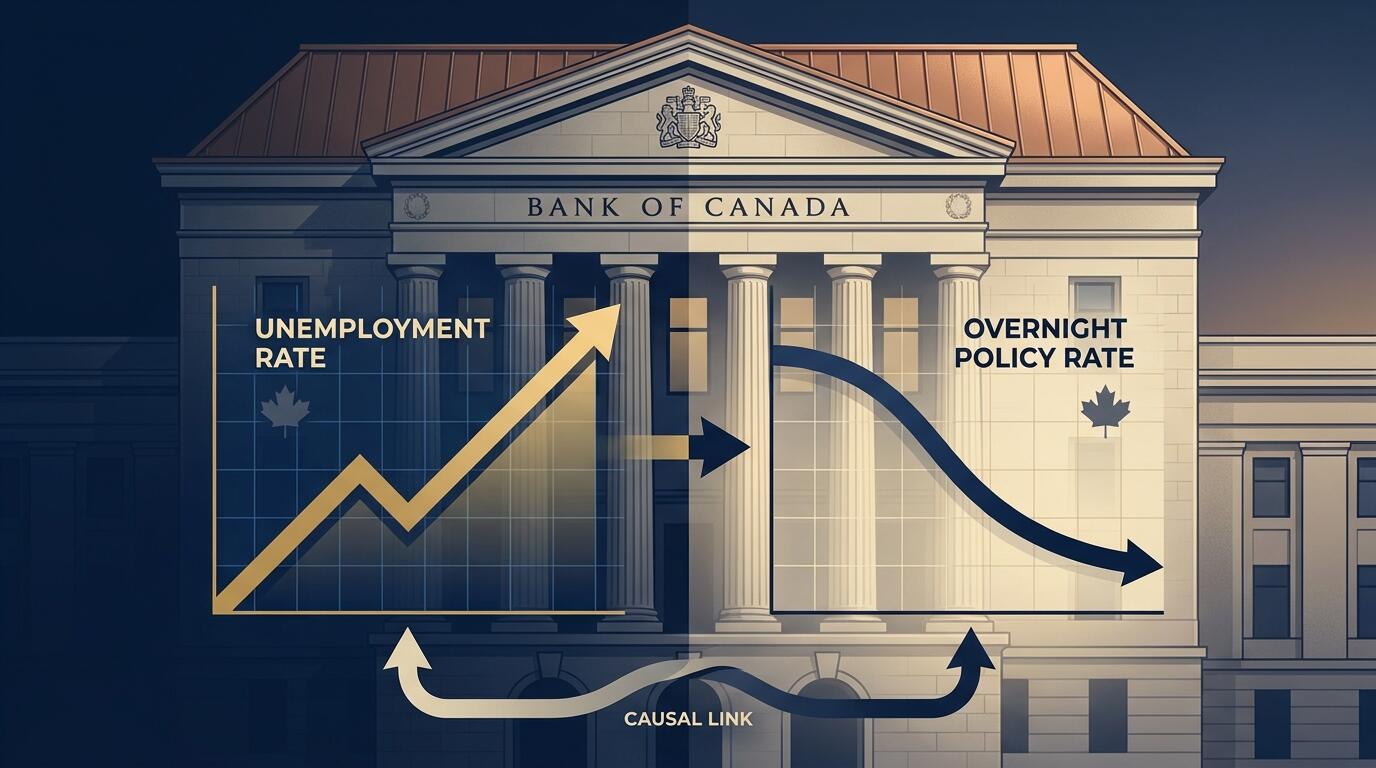
ALT: Bank of Canada rate cut outlook as rising unemployment signals potential monetary policy easing in Canada
Why Canada's Jobs Numbers Are Suddenly the Most Important Economic Story You're Following
Key Conclusion: When Canada's unemployment rate climbs, the Bank of Canada faces increasing pressure to lower its benchmark interest rate — a move that ripples through mortgages, savings accounts, business lending, and consumer confidence across the country. Understanding how labour market data feeds into central bank rate decisions helps everyday Canadians make sense of the economic forces shaping their financial lives, even if the underlying mechanics feel abstract at first.
The Bank of Canada — Canada's central bank, responsible for setting the country's overnight lending rate — watches the labour market with the same intensity a doctor monitors a patient's vital signs. When job growth slows and unemployment rises, it typically signals that economic activity is cooling, which gives the Bank both the justification and the political cover to reduce borrowing costs. This article unpacks that relationship in plain English: what rising unemployment actually measures, how the Bank of Canada's rate decisions work, and what a shift in monetary policy could mean for people navigating mortgages, savings, and everyday financial decisions.
At Vega Brief, a pattern we consistently see in our explainer work is that readers understand the what of a headline — "unemployment rises," "central bank cuts rates" — but struggle to connect the two in a way that feels personally relevant. That gap is exactly what this piece is designed to close.
Who This Article Is For — and What It Won't Do
Applicable Scenarios:
You've seen headlines about Bank of Canada rate decisions and want to understand what's actually driving them
You're a renter or homeowner trying to figure out whether borrowing costs might change in the near term
You're a young professional, student, or first-time investor trying to build financial literacy around Canadian macroeconomics
You want a clear, jargon-free breakdown of how unemployment data connects to central bank policy
Not Applicable/Cautions:
This article does not provide investment advice, financial planning guidance, or recommendations about specific financial products
Macroeconomic indicators like unemployment are lagging and imprecise — they describe the past, not the future, and central bank decisions involve far more variables than any single data point
The Connection Between Jobs Data and Interest Rates in Canada
The Bank of Canada is Canada's central bank — a federally mandated institution responsible for keeping inflation low, stable, and predictable, while also supporting sustainable economic growth. Its primary tool for doing this is the overnight interest rate, sometimes called the policy rate, which influences what banks charge each other to borrow money overnight. That rate, in turn, affects everything from variable-rate mortgages to business lines of credit to the interest your savings account earns.
Unemployment, in this context, is not just a social statistic — it is a direct input into monetary policy decisions. When employers stop hiring or begin laying off workers, it usually means businesses are pulling back on spending and investment. That contraction tends to reduce inflationary pressure, because fewer employed people means less overall spending power in the economy. Lower inflation pressure, in turn, gives the Bank of Canada room to cut its policy rate without risking a price spiral.
Statistics Canada — the federal agency responsible for measuring employment and labour market conditions — releases monthly Labour Force Survey data that the Bank of Canada and financial markets watch closely. A single month of weak data rarely changes the Bank's course; central banks tend to look at trends over multiple months. But when the data consistently points in one direction — as it did during the cooling period following the post-pandemic hiring surge — the signal becomes harder to ignore.
Canadian Mortgage Trends, a publication that closely tracks mortgage market conditions and central bank policy, has reported extensively on how a sustained rise in Canada's unemployment rate increased market expectations for earlier and more aggressive rate cuts. Similarly, the Financial Post has noted that weak jobs readings directly raise the odds of a Bank of Canada rate reduction, reflecting how sensitive financial markets are to labour market signals.
For readers who want a parallel look at how the same dynamic plays out in the United States, our piece on how the Federal Reserve's current rate decisions affect your mortgage and savings offers useful context — the mechanics of central bank rate-setting are broadly similar across both countries, even if the specific mandates and decision-making structures differ.
Step 1: Reading the Jobs Report
When Statistics Canada releases monthly employment figures, the Bank of Canada's economists and governing council members don't just look at the headline unemployment rate. They examine the composition of job gains and losses — are full-time jobs growing or shrinking? Is labour force participation rising or falling? Are wage gains accelerating in ways that could sustain inflation?
A single month of rising unemployment doesn't trigger a rate cut. What the Bank is looking for is a pattern — a consistent deterioration in labour market conditions that suggests the economy is running below its potential. When that pattern emerges and persists, the case for easing monetary policy becomes stronger. This step typically involves months of data accumulation before the Governing Council reaches a clear consensus.
Step 2: Weighing Unemployment Against Other Indicators
The Bank of Canada never makes rate decisions based on one data point. Unemployment figures are weighed against GDP growth numbers, inflation readings (measured by the Consumer Price Index), business confidence surveys, housing market data, and global economic conditions — particularly what's happening in the United States, Canada's largest trading partner.
Rising unemployment that coincides with easing inflation creates a cleaner case for rate cuts. But rising unemployment alongside persistent inflation — a scenario economists call "stagflation" — puts the Bank in a genuinely difficult position. In that case, cutting rates could reignite price pressures, while holding rates could deepen the labour market downturn. This balancing act is why monetary policy commentary is almost always full of hedged language.
Step 3: Communicating the Decision and Its Implications
The Bank of Canada holds eight scheduled rate announcement dates each year. Each announcement is accompanied by a press release, and periodically by a full Monetary Policy Report that outlines the Bank's forecasts and reasoning. Financial markets, mortgage lenders, and businesses parse every word of these communications for signals about future rate direction — a practice called "forward guidance."
When the Bank signals that it is watching labour market deterioration closely, that language alone can shift market expectations and affect lending rates before any official cut is made. Understanding this communication loop is essential to making sense of why mortgage rates sometimes move ahead of — or behind — official Bank of Canada announcements.
How Different Economic Conditions Shape the Rate Cut Calculus
The relationship between unemployment and rate decisions is not one-size-fits-all. The table below illustrates how different combinations of economic conditions typically influence the Bank of Canada's posture — though every scenario involves judgment, not formula.
Economic Condition — Likely Bank of Canada Posture — Implication for Borrowers
Rising unemployment + falling inflation — Strong case for rate cuts — Variable mortgage rates likely to decline
Rising unemployment + persistent inflation — Uncertain; cautious approach — Rate movement unclear; watch for Bank signals
Low unemployment + high inflation — Rate hikes or holds — Borrowing costs elevated; savings rates higher
Stable unemployment + inflation near 2% target — Neutral; no urgency to move — Rates likely stable; predictable borrowing environment
Rapid unemployment spike (recession signal) — Emergency cuts possible — Rates fall quickly but economic anxiety rises
This framework helps explain why financial markets don't just react to a single unemployment number — they react to what that number implies about the combination of conditions the Bank is navigating.
What "Rising Unemployment" Actually Looks Like in Practice
Unemployment is not a binary condition. Canada's official unemployment rate, as measured by the Labour Force Survey, captures people who are actively looking for work but cannot find it. But economists and the Bank of Canada also watch a broader set of indicators: the underemployment rate (which includes people working part-time who want full-time work), labour force participation, and youth unemployment, which tends to be more sensitive to economic cycles.
When we talk about "rising unemployment" in the context of Bank of Canada rate cut expectations, we're typically talking about a move of even a fraction of a percentage point over several months — because Canada's labour market, measured in millions of workers, means small percentage shifts represent large numbers of people. A rise from 5.8% to 6.5% over six months, for example, would represent a meaningful deterioration in labour market health and would almost certainly factor heavily into the Bank's deliberations.
The Bank's dual mandate also matters here. Unlike the U.S. Federal Reserve, which has an explicit dual mandate covering both price stability and maximum employment, the Bank of Canada's primary mandate is price stability — keeping inflation at or near its 2% target. Employment is not formally a co-equal goal. However, the Bank explicitly acknowledges that sustained high unemployment represents economic slack — unused productive capacity — that tends to push inflation lower over time. So even within a price-stability mandate, rising unemployment is a signal the Bank cannot ignore.
How this affects mortgages and borrowing costs is where the story becomes personally relevant for most Canadians. Canada's mortgage market is unusually sensitive to central bank policy because a large share of Canadian mortgages carry variable rates or have relatively short fixed-rate terms of one to five years, requiring frequent renewal. When the Bank of Canada cuts its overnight rate, lenders typically reduce their prime rate, which directly lowers variable-rate mortgage payments. For homeowners with variable-rate mortgages — or those approaching a renewal — a rate-cut cycle triggered by rising unemployment can meaningfully reduce monthly costs.
For savers, the story runs in the opposite direction: lower rates mean lower returns on high-interest savings accounts and GICs (Guaranteed Investment Certificates). This is not inherently good or bad — it reflects the trade-off the Bank is making between supporting economic activity and rewarding savers.
Advanced Considerations: Where the Narrative Gets More Complicated
Unemployment can rise for different reasons — and those reasons matter. A labour market where unemployment is climbing because workers are voluntarily leaving jobs to seek better ones (a "quits-driven" rise) looks very different from one where unemployment is rising because businesses are cutting headcount. The Bank of Canada distinguishes between these dynamics because they carry very different implications for wage growth, inflation, and overall economic momentum.
The timing lag is a persistent challenge. Monetary policy works with long and variable lags — it typically takes six to eighteen months for a rate change to fully filter through the economy. This means the Bank is always trying to anticipate future conditions rather than simply react to current ones. A rate cut made in response to rising unemployment today might not be felt in the real economy until well after labour market conditions have already stabilized or reversed.
A common misconception worth clearing up: many people assume that a rate cut is unambiguously "good news." In reality, rate cuts are often made in response to deteriorating economic conditions — rising unemployment, falling growth, weakening consumer confidence. The cut itself may help over time, but the circumstances that prompted it are, by definition, a sign of economic stress. Financial markets sometimes rally on rate cut news, which can create the misleading impression that falling interest rates mean everything is fine.
There is also a housing market dimension that is particularly acute in Canada, where residential real estate represents an outsized share of household wealth. Rate cuts tend to stimulate housing demand — potentially reigniting price pressures in markets like Toronto and Vancouver that remain structurally constrained on supply. This creates a feedback loop the Bank monitors carefully: cut rates to ease unemployment pressures, but risk re-inflating a housing bubble that creates its own financial stability concerns.
ALT: Bank of Canada overnight policy rate versus Canadian unemployment rate trend, showing rate cut patterns and labour market conditions
Q1: How does the Bank of Canada actually decide when to cut rates?
The Bank of Canada's Governing Council meets eight times a year to set the overnight policy rate. Decisions are based on a comprehensive review of economic data — including employment figures from Statistics Canada, inflation data, GDP readings, and global economic conditions. The council looks for sustained trends rather than single data points, and publishes detailed reasoning in its Monetary Policy Reports. There is no automatic formula — the process involves significant judgment about current conditions and future risks.
Q2: Are variable-rate mortgage holders directly affected by Bank of Canada rate cuts?
Yes, in most cases. When the Bank of Canada lowers its overnight rate, major Canadian banks typically lower their prime lending rate by the same amount, usually within days. Variable-rate mortgages are priced at a spread above or below prime, so payments adjust accordingly. Fixed-rate mortgages are influenced more by Government of Canada bond yields than by the overnight rate directly, though bond markets often move in anticipation of Bank of Canada decisions. Specific product terms vary by lender.
Q3: How long does it take for a Bank of Canada rate cut to affect the broader economy?
Economists generally estimate that monetary policy changes take six to eighteen months to fully work through the economy — a lag that makes central banking as much art as science. The Bank must therefore make decisions based on where it expects the economy to be in the future, not just where it is today. This is why forward guidance and communication are so central to modern central banking: signaling intent can itself shift expectations and behaviour before any official rate change takes effect.
The Bottom Line
Rising unemployment in Canada is not just a statistic — it is one of the clearest signals that the Bank of Canada watches when deciding whether to lower its overnight interest rate. Three core points bear repeating:
First, the relationship between labour market data and rate decisions is real but not mechanical. The Bank weighs employment figures alongside inflation, GDP, and global conditions before acting. No single jobs report determines policy.
Second, rate cuts triggered by rising unemployment carry a dual nature. They reduce borrowing costs for variable-rate mortgage holders and businesses, but they also reflect economic stress that affects workers, consumers, and the broader growth outlook.
Third, understanding this relationship — even at a general level — helps Canadians interpret financial news more confidently and recognize how macro forces connect to personal financial decisions, without needing to be professional economists.
The next time you see a headline about unemployment data and Bank of Canada speculation, you'll have the framework to read between the lines.
If making sense of Canada's economic headlines — from central bank rate decisions to labour market shifts — is something you find yourself doing more often, Vega Brief is built for exactly that. Visit the site for clear, source-linked financial news explainers, delivered in plain English and updated as the story evolves.
Sources
Financial Post. "Weak jobs reading raises odds of Bank of Canada rate cut."
https://financialpost.com/news/economy/weak-jobs-reading-raises-odds-bank-canada-rate-cut
Canadian Mortgage Trends. "Will rising unemployment hasten the Bank of Canada's coming rate cuts?"
https://www.canadianmortgagetrends.com/2024/07/will-rising-unemployment-hasten-the-bank-of-canadas-coming-rate-cuts/
Bank of Canada. Official institutional website and monetary policy resources.
https://www.bankofcanada.ca
Note: Economic data and central bank policy change frequently. Always verify current conditions with official sources or qualified financial professionals.
For educational purposes only. Not investment advice. We do not recommend any stock, fund, broker or trading platform. Headlines are sourced from Google News · Business; every story links to the original publishers.