Core Inflation vs. Headline Inflation: Why the Difference Matters Right Now
ALT: Core inflation vs headline inflation comparison chart showing why the difference matters for economic policy
For educational purposes only. Not investment advice.
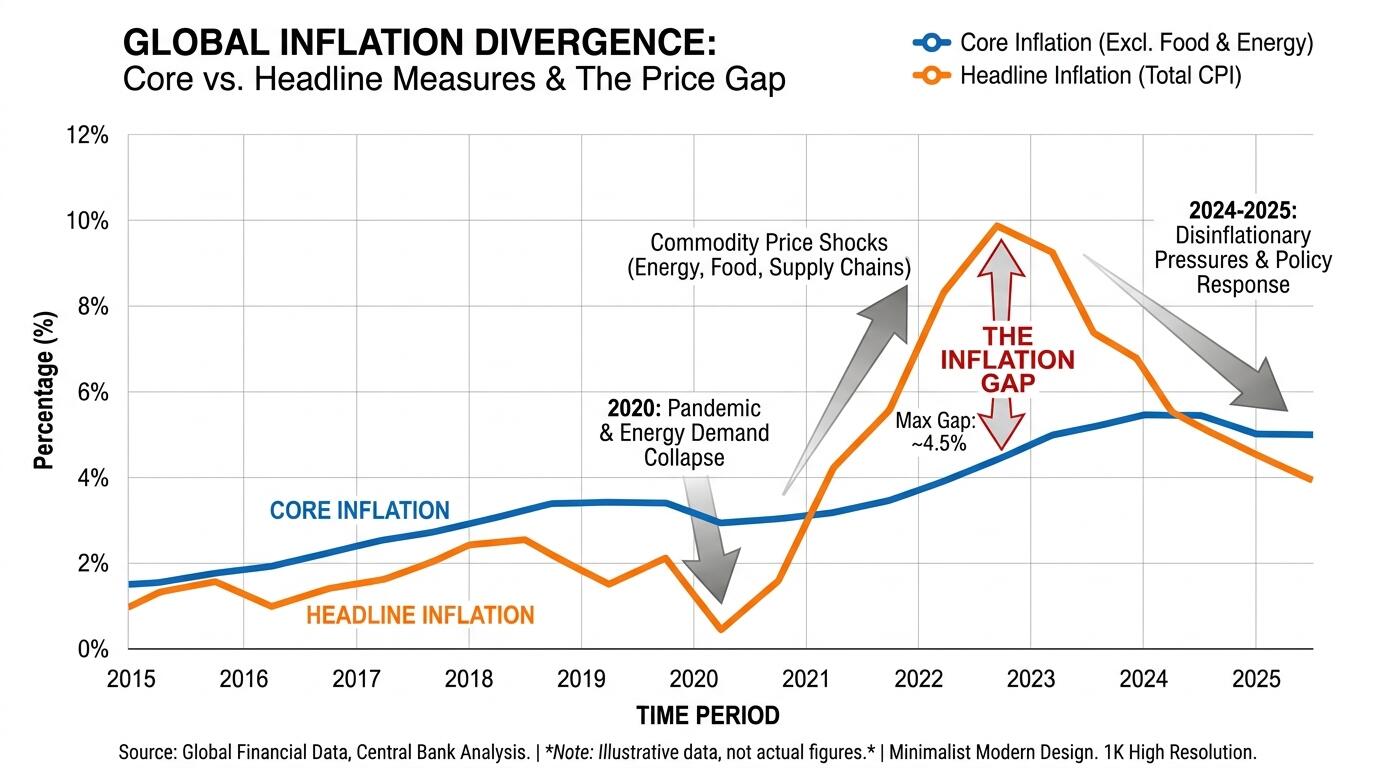
ALT: Core inflation vs headline inflation comparison chart showing why the difference matters for economic policy
Why Core Inflation and Headline Inflation Tell Very Different Stories — and Why Both Matter Right Now
When inflation is dominating the news, it pays to read the fine print. Headline inflation and core inflation are not the same measure, and in periods of economic turbulence, the gap between them can shape interest-rate decisions, household budgets, and government policy in ways that ripple across everyday life.
In our work at Vega Brief explaining financial news to readers without a finance background, a pattern we consistently see is confusion about why some reports cite one inflation figure while others cite a different one — and why commentators sometimes seem to be talking about completely different economic realities. The comparison here is straightforward: headline inflation versus core inflation, judged on what each measures, how central banks use each figure, what the numbers mean for consumers, and which one gives the clearest signal about where the economy is heading.
Understanding What These Two Inflation Measures Are Actually Tracking
Headline inflation is the broadest measure of price changes across the whole economy. Core inflation is a narrower measure that strips out food and energy prices to reveal the underlying, longer-term trend in price pressures.
That single distinction — whether volatile categories like food and energy are included or excluded — is the engine behind most of the disagreement you hear among economists and policymakers. Headline inflation tells you what life costs right now, in full. Core inflation tells you where prices are most likely to settle once the temporary shocks fade. Neither measure is wrong; they answer different questions.
The criteria on which this comparison turns are: measurement scope, policy relevance, consumer relevance, volatility and signal clarity, timeliness, and usefulness for forecasting. Each criterion matters for a different reason, as the next section explains.
The Criteria That Make This Comparison Matter
Evaluating these two inflation measures against each other requires being precise about what we want an inflation figure to do.
Measurement scope defines what basket of goods and services is captured. A broader basket reflects the full cost of living; a narrower one deliberately omits categories that economists consider noisy in the short term. Understanding scope tells you immediately what a figure can and cannot represent.
Policy relevance describes how much weight central banks — particularly the Federal Reserve in the United States — give each measure when setting interest rates. If policymakers rely primarily on one measure, then the other may dominate the news but have less direct effect on borrowing costs.
Consumer relevance is the mirror image of policy relevance: how closely does the measure match what people actually pay? Readers who feel their grocery bills rising faster than any official figure suggests need to understand why that gap can exist.
Volatility and signal clarity matter because a figure that swings dramatically from month to month is harder to act on. A clear, stable signal is more useful for long-term decisions — whether you are a central banker setting rates or a family planning a budget.
Timeliness refers to how quickly the measure reflects real-world changes. A figure that lags reality too much is less useful; one that is too reactive may send false alarms.
Forecasting usefulness asks which measure does a better job of predicting where inflation will be in six, twelve, or eighteen months — the horizon that matters most for monetary policy and for household financial planning.
Headline Inflation: The Full Picture of Rising Prices
Headline inflation is the total measure of price change across a defined basket of consumer goods and services, including food and energy. In the United States, the most widely cited headline figures come from the Consumer Price Index (CPI), published by the Bureau of Labor Statistics, and the Personal Consumption Expenditures (PCE) price index, published by the Bureau of Economic Analysis. Both are official government statistics. Headline inflation is what you see on the front page of a newspaper when a story says "prices rose by X percent." It captures the actual, lived experience of consumers at the checkout counter and the gas station — including all the categories that fluctuate most sharply when oil markets shift or harvests fail.
The strength of headline inflation is its honesty about the full cost of living. Its weakness is that it can move sharply in either direction based on events — a geopolitical conflict that disrupts oil supply, a drought that damages crop yields — that may have nothing to do with the deeper forces driving the economy.
Core Inflation: The Signal Beneath the Noise
Core inflation is headline inflation with food and energy prices removed. The rationale, as explained by the Federal Reserve, is that food and energy prices are subject to large, sudden swings driven by factors outside the domestic economy — weather events, commodity-market shocks, international supply disruptions — that do not necessarily reflect persistent inflation trends. By stripping out these components, core inflation aims to reveal the underlying momentum of price increases across the rest of the economy: services, shelter, vehicles, healthcare, and most manufactured goods.
Core inflation is the measure that Federal Reserve officials have historically emphasized when discussing monetary policy. A Federal Reserve speech on the subject, delivered by then-Governor Frederic Mishkin in 2007, laid out the logic clearly: headline inflation is important for measuring the cost of living, but core inflation tends to be a better predictor of future headline inflation itself, making it more useful as a guide for policy. Core inflation moves more slowly and is less susceptible to temporary spikes, which gives policymakers a cleaner baseline from which to judge whether rate changes are needed.
The weakness of core inflation is the one that ordinary consumers feel immediately: food and energy are not optional. Excluding them can make official figures seem disconnected from what people experience at the pump or the supermarket — particularly during periods when energy or food prices are rising sharply for extended periods.
Head-to-Head Comparison: Core vs. Headline Across Six Criteria
Criterion — Headline Inflation — Core Inflation
Measurement Scope — Full consumer basket, including food and energy — Consumer basket excluding food and energy
Policy Relevance — Important reference, but secondary to core for rate decisions — Primary guide for central bank interest rate decisions
Consumer Relevance — High — reflects full lived experience of price changes — Lower — omits categories that represent significant household spending
Volatility and Signal Clarity — Higher volatility; subject to commodity-market shocks — Lower volatility; smoother trend signal
Timeliness — Immediate reflection of all price changes — Lags commodity shocks by design; better reflects durable trends
Forecasting Usefulness — Useful short-term indicator; less reliable for long-term trend — Stronger predictor of where inflation is heading over six to eighteen months
The table above makes the core trade-off clear. Headline inflation and core inflation are not rivals designed to produce opposite results — they are complementary instruments designed for different purposes.
For understanding the current economic moment, a few interpretive points are worth drawing out.
First, when headline and core inflation diverge sharply, it almost always reflects a commodity-price shock. If energy prices surge, headline inflation jumps while core inflation may remain relatively steady. Central banks in this situation face a genuine dilemma: do they respond aggressively to headline numbers that reflect a temporary supply disruption, or do they remain patient and trust the smoother core signal? Getting this call wrong in either direction has real consequences for employment and growth.
Second, when headline and core inflation move together and in the same direction over an extended period, that convergence is a strong warning signal. It suggests that initial commodity-price pressures have worked their way through the broader economy — into wages, rents, and services — and that inflation has become more entrenched. This scenario is particularly challenging for central banks because it requires sustained tightening of monetary policy rather than a temporary adjustment.
Third, academic research — including a study from the University of Texas at Dallas examining the choice between core and headline inflation — has highlighted that neither measure is universally superior across all economic environments. The right measure to emphasize depends on the nature of the shock driving inflation, which means readers should be skeptical of any commentator who insists that only one figure tells the true story.
Which Should You Pay Attention To? Scenario Recommendations
The honest answer is: both, depending on what question you are trying to answer. Here is how to map your own situation to the most relevant measure.
If you are trying to understand your own budget and cost of living: Headline inflation is your number. It includes what you spend on groceries, gasoline, and utilities. When the gap between headline and core is wide, it usually means energy or food costs are driving your budget harder than the core figure would suggest. You are not imagining it — the core measure genuinely does not capture that squeeze.
If you are trying to understand what the Federal Reserve is likely to do with interest rates: Focus on core inflation, and specifically on the core PCE index, which the Fed has historically treated as its primary benchmark. When core inflation remains elevated even as headline inflation moderates, the Fed is more likely to keep rates higher for longer. When core inflation falls steadily, rate cuts become more plausible. Understanding this helps you make sense of financial news about mortgage rates, savings account yields, and borrowing costs.
If you are trying to gauge the long-term economic outlook: Both measures matter, but their relationship to each other is the most informative signal. A widening gap — headline well above core — often signals a temporary supply shock. A narrowing gap, especially with both measures falling, typically signals that inflationary pressures are genuinely easing across the economy.
If you are evaluating financial news coverage: Be aware that different outlets may emphasize different measures, sometimes without explaining why. A headline that says "inflation falls to X percent" may be citing core inflation, which could look meaningfully different from the headline figure reported in a different story the same week. Checking which measure is being cited is a basic act of financial literacy that changes how you read the news.
Pros of following headline inflation: Complete picture of consumer prices; honest about the full cost of living; directly relevant to personal budgeting.
Cons of following headline inflation: Volatile; susceptible to temporary shocks that may reverse quickly; less reliable as a predictor of future price trends.
Pros of following core inflation: Cleaner signal of underlying price momentum; more predictive of where the economy is heading; closely watched by the Federal Reserve.
Cons of following core inflation: Excludes categories that matter enormously to household budgets; can understate the real pain of commodity price surges.
ALT: Diagram comparing headline inflation and core inflation measures showing the inclusion and exclusion of food and energy price categories for consumer price index analysis
Q1: How does the Federal Reserve decide which inflation measure to prioritize?
The Federal Reserve has historically focused on core inflation — and specifically on the core Personal Consumption Expenditures (PCE) price index — as its primary benchmark for monetary policy decisions. The reasoning, as articulated by Federal Reserve officials over many years, is that core inflation provides a cleaner signal of underlying price pressures by excluding the volatile food and energy categories that can swing sharply due to temporary supply disruptions. Headline inflation remains important for context, but core inflation guides the direction of interest rate decisions.
Q2: Is core inflation a more accurate measure of inflation than headline inflation?
Neither measure is more "accurate" in an absolute sense — they measure different things. Core inflation is more accurate for identifying underlying, durable inflation trends and for forecasting where prices are heading over the next year or more. Headline inflation is more accurate for capturing what consumers actually pay, including food and energy. Academic research, including work examining the comparative predictive power of both measures, suggests the most informative approach is to track both and understand what each is designed to reveal.
Q3: When does the gap between core and headline inflation tend to be largest?
The gap between core and headline inflation tends to widen most during periods of sharp commodity-price movements — particularly oil and food price shocks. When energy prices spike rapidly due to geopolitical events or supply disruptions, headline inflation surges while core inflation may remain relatively stable, creating a significant divergence. The same dynamic works in reverse: a sharp fall in oil prices can pull headline inflation below core inflation. The Cleveland Federal Reserve's inflation nowcasting tools track these measures in near-real time, helping analysts monitor how the gap is moving.
Final Thoughts
The distinction between core inflation and headline inflation is not a technicality invented to confuse people — it is a genuinely important analytical tool that reflects different questions about the economy. At Vega Brief, a pattern we see consistently in our work explaining financial news is that readers who understand this distinction are far better equipped to make sense of economic headlines and to see through the noise of conflicting reports.
Three takeaways are worth keeping front of mind. First, headline inflation is your cost-of-living number: it tells you what the full economy costs right now, including food and energy. Second, core inflation is the policy number: it tells central banks — and therefore, indirectly, everyone who borrows or saves — where the economy's underlying price pressures are going. Third, the relationship between the two is itself a signal: when they diverge sharply, a temporary shock is likely at work; when they move together for an extended period, inflation has become more deeply embedded and harder to reverse.
The next time you see an inflation figure in a news headline, the most useful first question to ask is simply: which inflation are they talking about? That single question separates a clear reading of financial news from a confused one.
For clear, plain-English explanations of the latest economic and financial news — with no investment advice and no product pitches — explore Vega Brief, where every story is broken down into language that actually makes sense.
Sources & Citations
Federal Reserve. "Headline versus Core Inflation in the Conduct of Monetary Policy."
https://www.federalreserve.gov/newsevents/speech/mishkin20071020a.htm
Sul, D. et al. "Rethinking the choice between core and headline inflation." University of Texas at Dallas.
https://personal.utdallas.edu/~d.sul/papers/CORE23.pdf
Federal Reserve Bank of Cleveland. "Inflation Nowcasting."
https://www.clevelandfed.org/indicators-and-data/inflation-nowcasting
U.S. Bureau of Labor Statistics. Consumer Price Index Program.
https://www.bls.gov
U.S. Bureau of Economic Analysis. Personal Consumption Expenditures Price Index.
https://www.bea.gov
Note: Economic data and policy frameworks are updated regularly. Readers are encouraged to consult the latest official publications from the relevant government agencies and central bank communications for current figures.
For educational purposes only. Not investment advice. We do not recommend any stock, fund, broker or trading platform. Headlines are sourced from Google News · Business; every story links to the original publishers.