How Global Job Markets Compare Heading Into 2027
ALT: Global job market comparison chart showing employment trends across regions heading into 2027
For educational purposes only. Not investment advice.
ALT: Global job market comparison chart showing employment trends across regions heading into 2027
How the World's Job Markets Stack Up as 2027 Approaches
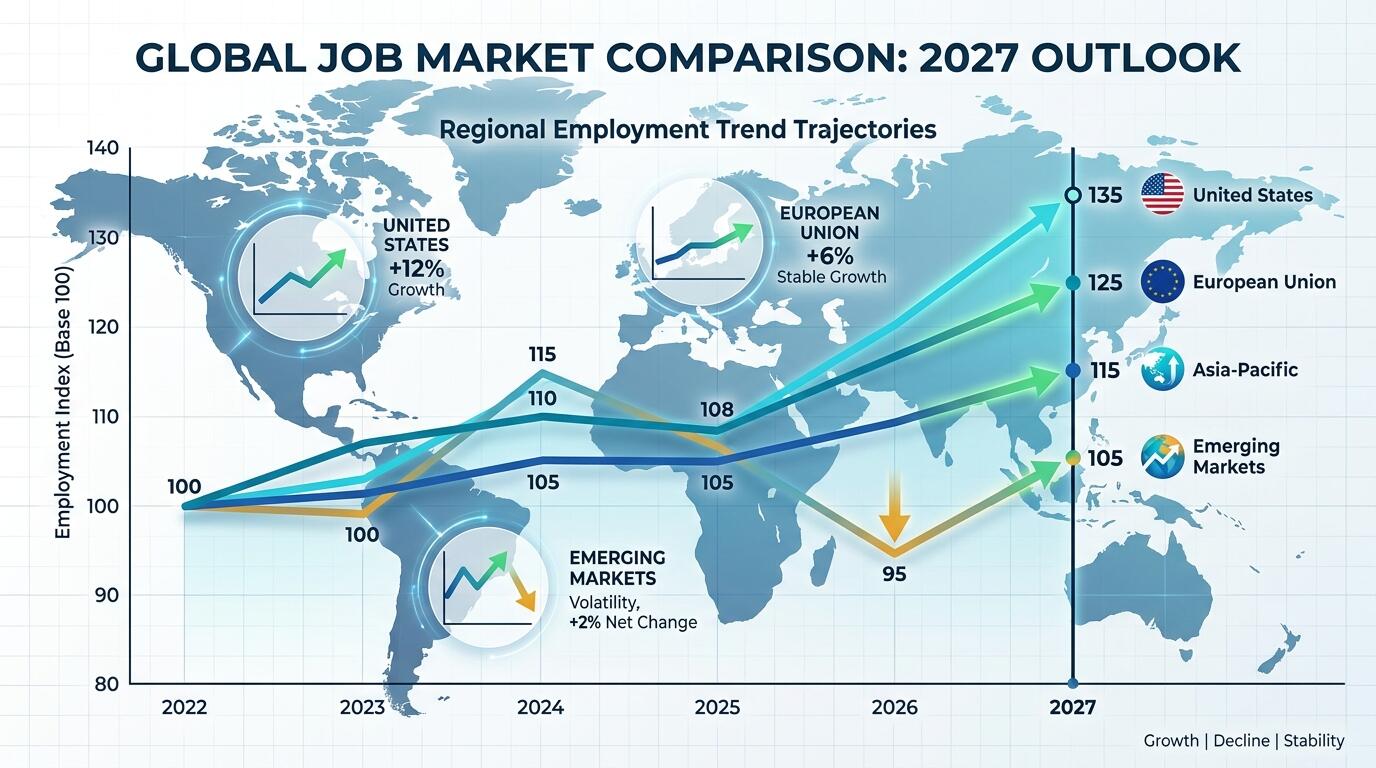
Key Conclusion: Heading into 2027, global job markets are diverging sharply rather than moving in unison. The United States continues to show resilience but with cooling momentum, Europe is grappling with structural unemployment and demographic strain, Asia-Pacific economies are experiencing uneven recoveries, and emerging markets face mounting pressure from automation and skills gaps. Understanding these regional differences — and the common threads running through all of them — is essential for anyone navigating careers, savings decisions, or economic news in the years ahead.
The world's labor markets do not move as one. As 2027 draws closer, some regions are adding jobs at a healthy clip, others are shedding them in certain sectors while creating them in new ones, and nearly all economies are wrestling with a shared challenge: the rapid shift in which skills actually matter. This article compares the major employment regions — the United States, the European Union, Asia-Pacific, and key emerging markets — across several practical dimensions, so you can make sense of the headlines without needing an economics degree.
The Criteria That Actually Matter When Comparing Job Markets
Comparing job markets fairly requires a consistent set of benchmarks. Here are the six dimensions this article uses to evaluate each region — and why each one matters to everyday readers.
Employment rate and headline unemployment is the most commonly cited statistic, but it tells only part of the story. A low unemployment figure can mask millions of people who have stopped looking for work entirely, or who are stuck in part-time roles they did not choose.
Job quality and wage growth matters because a market flooded with low-paying, insecure positions is very different from one creating stable, well-compensated roles. Real wage growth — how much purchasing power workers actually gain — is a more honest measure than nominal pay increases.
Sectoral shifts tracks which industries are expanding and which are contracting. The energy transition, the rise of artificial intelligence, and demographic changes are reshaping entire sectors simultaneously. A pattern we consistently see at Vega Brief is that readers are often caught off-guard when a headline says "jobs are growing" while their own sector is quietly shrinking.
Reskilling pressure captures how quickly workers need to update their skills to remain employable. According to research frequently cited in workforce development discussions, roughly half of all specialists will need significant reskilling by 2027 — a figure that underscores the pace of change in nearly every labor market.
Labor force participation tracks whether the working-age population is actually showing up to work or engage with the job market at all. Aging populations, changing attitudes toward work, and pandemic-era behavioral shifts have all made this metric more telling than ever.
Structural risks covers the longer-term vulnerabilities in each regional market — things like automation exposure, political instability affecting investment, or mismatches between education systems and employer needs. These are the factors that don't always make headlines but tend to define outcomes over a multi-year horizon.
The United States Labor Market
The United States job market is the world's largest single national labor market by nominal output and remains a critical benchmark for global comparisons. Heading into 2027, the U.S. market is best described as cooling from an unusually hot post-pandemic period rather than deteriorating. Hiring has slowed in rate-sensitive sectors like construction and finance — areas closely linked to the Federal Reserve's interest rate cycle — while healthcare, government services, and technology-adjacent roles continue to add workers.
Wage growth has moderated from its 2022 peaks, but remains above its pre-pandemic trend in many industries, particularly for workers without four-year college degrees who benefited from a tight labor market in trades and logistics. The bigger concern heading into 2027 is the emergence of AI-related displacement in white-collar fields. Indeed's Hiring Lab, which tracks job postings and labor market signals in real time, has flagged a cooling in demand for certain professional roles as employers experiment with AI-assisted workflows. This is not a collapse — it is a restructuring, and the difference matters enormously for how workers and policymakers should respond.
The United States also faces a structural tension: labor force participation among prime-age workers (those between their late twenties and mid-fifties) recovered well post-pandemic, but participation among older workers remains below pre-2020 levels, tightening the overall labor supply in ways that don't show up in standard unemployment figures.
The European Union Labor Market
The European Union, as a collective labor market, presents one of the more complex pictures globally. The EU is not a single job market — Germany's labor conditions differ substantially from Spain's or Poland's — but several broad trends apply across member states heading into 2027.
Headline unemployment across the eurozone has remained relatively low by historical standards, but the composition of employment is a source of concern. Youth unemployment remains stubbornly elevated in southern European countries, while northern economies face the opposite problem: not enough working-age people to fill available positions. Germany in particular is managing a demographic crunch that is forcing businesses to automate and recruit internationally at the same time.
The green transition is reshaping European manufacturing in real time. Traditional automotive jobs in Germany and central Europe are under pressure as the industry pivots toward electric vehicles, and the reskilling demands are significant. The EU has launched substantial funding mechanisms to address this, but the gap between policy ambition and on-the-ground training capacity remains wide. This connects directly to broader economic pressures — as economists watching European fiscal conditions have noted, government balance sheets constrain how aggressively member states can fund retraining programs.
Asia-Pacific Labor Markets
Asia-Pacific is not a single labor market — it spans economies as different as Japan, India, Vietnam, and Australia — but the region collectively represents the largest share of the global workforce and the most dynamic range of employment conditions.
Japan and South Korea face acute demographic challenges, with shrinking working-age populations driving labor shortages even in the absence of strong GDP growth. Both countries have accelerated immigration and automation investment as partial responses, though cultural and political resistance to large-scale immigration continues to constrain that option.
India stands out as the region's most significant story. With the largest youth population in the world, India has enormous potential labor supply — but matching that supply to quality job opportunities remains a persistent challenge. Formal employment growth has lagged population growth, and the skills mismatch between graduates and employer needs is well-documented. The surge in AI investment propping up global growth heading into 2027 is relevant here: India's technology sector is both a beneficiary and a disruptor, creating high-skilled jobs while automating lower-skilled ones.
China's labor market is navigating a more complex transition than most Western commentary captures. Youth unemployment hit record highs in recent years before authorities briefly stopped publishing the data. The structural shift away from manufacturing toward services and domestic consumption is ongoing, but uneven.
Emerging Markets Beyond Asia
Beyond Asia-Pacific, emerging economies in Latin America, Sub-Saharan Africa, and the Middle East face a distinct set of pressures. Informal employment — work outside formal employment contracts and social protection systems — dominates in many of these regions, meaning that standard unemployment statistics systematically understate labor market stress.
Automation is arriving in these markets at a time when the manufacturing jobs that historically helped earlier generations escape poverty are becoming less available globally. At the same time, mobile technology and digital platforms are creating new forms of gig-economy work that offer income without stability.
Head-to-Head Comparison Across Key Criteria
Criterion — United States — European Union — Asia-Pacific — Emerging Markets
Headline unemployment trend — Cooling but stable — Low overall, high youth unemployment in south — Mixed — tight in Japan/Korea, elevated in parts of India/China — Elevated; informal work obscures true figures
Wage growth (real terms) — Moderating from highs — Modest; varies sharply by member state — Strong in parts of Southeast Asia; stagnant in Japan — Inconsistent; inflation erodes gains in many markets
Sectoral shift intensity — High — AI and green energy reshaping hiring — High — EV transition pressuring manufacturing — High — technology sector driving divergence — Moderate — automation risk rising
Reskilling pressure — High — especially in white-collar roles — High — green transition demands new skills — High in tech-heavy economies; lower elsewhere — High in theory; training infrastructure limited
Labor force participation — Recovering, with gaps among older workers — Aging workforce straining participation rates — Declining in Japan/Korea; surplus in India — Large youth bulge; participation constrained by informal economy
Structural risk level — Moderate — AI displacement, political uncertainty — Moderate-to-high — demographics and fiscal constraints — Varies widely — low in Singapore/Australia, high in some developing economies — High — limited safety nets, automation exposure
The table reveals a pattern that surfaces repeatedly in our work explaining economic headlines: every major regional labor market is under structural pressure, but the nature of that pressure differs significantly. The United States and Europe are primarily navigating how to reallocate workers within developed economies as AI and green energy change which skills are valuable. Asia-Pacific is managing a split between rapidly modernizing economies and those with large informal or agricultural workforces. Emerging markets outside Asia face the steepest climb — dealing with weak safety nets and automation exposure at the same time.
One common thread worth highlighting: reskilling pressure is universally high across all four regions. The specific skills in demand differ, but the urgency of continuous learning as a career strategy applies everywhere. Research from workforce development analysts suggests that approximately half of all specialists globally will require significant reskilling by 2027, driven primarily by AI adoption and the green energy transition — a figure that should prompt serious attention regardless of where you live or work.
Another notable finding: wage statistics in isolation are misleading. Real wages — that is, wages adjusted for what prices actually are — tell a more accurate story than nominal figures, and in several major economies, inflation has eroded nominal wage gains significantly over the past two years. This gap between what payslips say and what purchasing power workers actually have is a source of real frustration that gets lost when media coverage focuses solely on unemployment rates.
Which Job Market Outlook Should Shape Your Thinking? Scenario Recommendations
Different readers are in very different situations, and the global job market picture affects people in distinct ways depending on where they are and what they do for a living.
If you are an early-career professional in the United States or Europe, the most actionable implication of this comparison is the reskilling pressure. Waiting for your employer or your government to hand you a retraining program is a strategy that carries real risk. The workers who are navigating sector transitions most successfully are those who are proactively building skills adjacent to AI tools, renewable energy systems, or healthcare — regardless of what field they started in.
If you are a mid-career professional in a trade or skilled service role, the picture is more encouraging. Labor shortages in healthcare, infrastructure, and skilled trades are a genuine and durable feature of the U.S. and European labor markets heading into 2027. These roles have proven more resistant to AI displacement than many white-collar knowledge-worker positions, and real wage growth in these fields has outpaced much of the rest of the economy in recent years.
If you are following global markets for investment or savings purposes, the divergence between regional job markets matters because employment conditions are a leading signal for consumer spending, interest rate decisions, and corporate earnings. A cooling U.S. labor market, for example, gives the Federal Reserve more room to consider adjusting rates — a dynamic that flows through to mortgage rates, bond yields, and savings account returns. Understanding how rate decisions connect to labor market conditions is a useful frame for making sense of financial headlines.
If you are based in an emerging market or have financial ties to one, the structural risks are significant enough to warrant genuine caution. Markets where informal employment dominates and safety nets are thin are more exposed to sudden shocks — from commodity price swings to trade policy changes — than headline growth statistics typically suggest.
Pros and cons summary:
The U.S. labor market offers dynamism and relatively strong wage floors, but comes with high reskilling demands and growing AI displacement risk in professional roles. The EU offers stronger social protections but faces demographic headwinds that are not easily resolved. Asia-Pacific's diversity is both its strength and its complexity — some of its economies are among the world's most dynamic, while others face deep structural challenges. Emerging markets carry the highest structural risk but also have young workforces that could, with the right investment in education and infrastructure, be significant growth engines.
ALT: Infographic comparing global job markets across the United States, Europe, Asia-Pacific, and emerging economies with key employment criteria for 2027
Q1: How does the U.S. job market compare to Europe's heading into 2027?
The U.S. labor market is cooling from a post-pandemic high but remains more flexible and dynamic than most of Europe. European markets generally offer stronger worker protections and more generous social safety nets, but face sharper demographic constraints — especially in Germany and southern Europe. The U.S. is seeing greater AI-driven disruption in white-collar roles, while Europe's most acute challenge is the green energy transition reshaping its manufacturing base. Both regions face high reskilling pressure, but through different sectoral channels.
Q2: Are global job markets at risk of significant disruption from AI by 2027?
Yes — AI disruption is a documented and measurable trend rather than a hypothetical. Research cited by workforce analysts suggests roughly half of all specialists will need meaningful reskilling by 2027, driven primarily by AI adoption across industries. The disruption is uneven: roles involving routine information processing face the highest exposure, while skilled trades, healthcare, and roles requiring complex human judgment have shown more resilience. The risk is not mass unemployment but a mismatch between existing skills and emerging employer needs — a distinction that matters enormously for how workers should plan.
Q3: How long will the current global labor market uncertainty last?
Labor market transitions driven by structural forces — like AI adoption and energy-sector shifts — typically play out over several years rather than months. Most labor economists expect the current period of elevated uncertainty and reskilling pressure to persist through at least the late 2020s. The pace will vary by region: economies with stronger education and training infrastructure will adapt faster, while those with weaker institutional capacity face a longer adjustment. Headline unemployment figures may stay relatively stable even as the composition of work changes substantially underneath them.
Wrapping Up
Global job markets heading into 2027 are diverging in ways that matter for careers, savings, and economic decision-making — and the standard headlines often miss the nuance.
Key Takeaways:
Every major regional labor market is under structural pressure, but the specific drivers differ: AI displacement in the U.S. and white-collar sectors, green transition in Europe, demographic strain in East Asia, and informal economy exposure in emerging markets.
Reskilling pressure is the single most consistent theme across all regions — approximately half of specialists globally are projected to need meaningful upskilling by 2027.
Headline unemployment figures understate the true complexity of labor markets; real wage growth, labor force participation, and sectoral shifts paint a more accurate picture.
The divergence between regional markets creates different implications for workers, savers, and anyone following economic news — there is no single global story, only regional ones that intersect.
Structural risks — from AI displacement to demographic decline to thin safety nets in emerging markets — are real and measurable, not hypothetical, and should inform how people plan their careers and finances over the next several years.
The next step is staying informed about how these trends evolve — because the labor market story heading into 2027 will keep shifting, and the people who understand the dynamics will be far better positioned than those relying on oversimplified headlines.
Start making sense of the economic trends shaping your working life and financial future by visiting Vega Brief — plain-English explainers on the financial and economic news that actually affects you.
References
Elvtr. "50% of Specialists Will Need Reskilling By 2027".
https://elvtr.com/blog/50-of-specialists-will-need-reskilling-by-2027
Indeed Hiring Lab. "Economists Expect a Cooled Labor Market and an AI Impact on Hiring — Q2 Labor Market Outlook Survey".
https://hiringlab.indeed.com/2026/08/05/q2-labor-market-outlook-survey/
For educational purposes only. Not investment advice. We do not recommend any stock, fund, broker or trading platform. Headlines are sourced from Google News · Business; every story links to the original publishers.