How Rising Government Debt Could Affect Everyday Borrowing Costs in 2026
ALT: Rising government debt affecting everyday borrowing costs including mortgages and loans in 2026
For educational purposes only. Not investment advice.
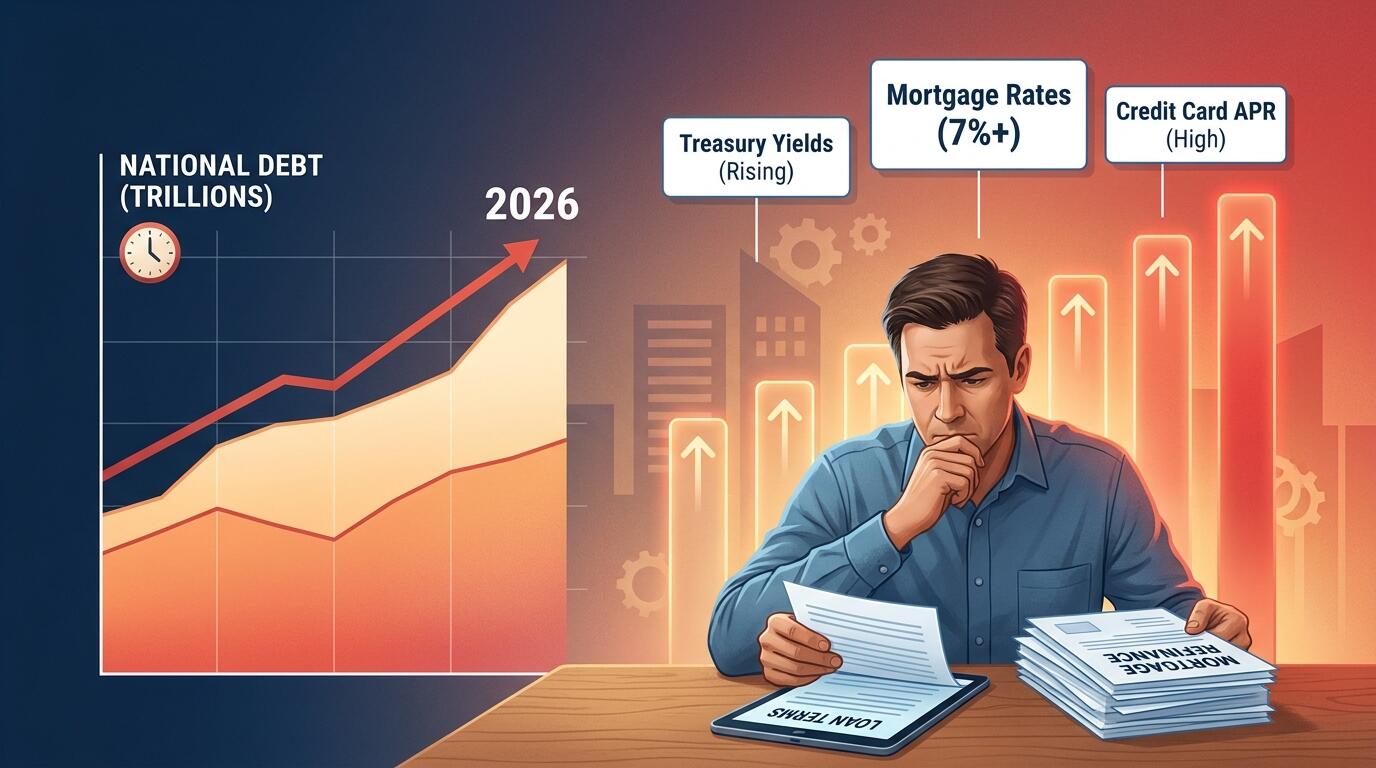
ALT: Rising government debt affecting everyday borrowing costs including mortgages and loans in 2026
Why Your Next Loan Could Cost More: Government Debt and Borrowing Costs in 2026
Imagine you're planning to refinance your mortgage this year, or you're a small business owner hoping to take out a loan to expand. You've done everything right — decent credit score, steady income — but the interest rate you're quoted feels uncomfortably high. What's going on? The answer may have less to do with your personal finances and more to do with the size of your government's debt pile.
Government debt — the total amount a country's national government owes to creditors — has been climbing in the United States and across many major economies. As that debt grows, it sends ripple effects through the financial system in ways that directly touch everyday borrowers: the rate on your car loan, the interest on your credit card, the monthly payment on a new mortgage. Understanding how these connections work is the first step to making sense of the headlines.
This article breaks down the key mechanisms through which rising public debt can push up the cost of borrowing for ordinary people in 2026. Each item is drawn from well-established economic concepts documented by institutions including the Yale Budget Lab, the Wharton Budget Model, and the Bipartisan Policy Center. Whether you're a first-time homebuyer, a student managing loan repayments, or simply someone trying to understand the news, this list gives you a plain-English map of a complex but genuinely important topic.
Higher Treasury Yields Signal Higher Costs Across the Board
Treasury yields — the interest rates the U.S. government pays on its own borrowing — are the foundation on which most other interest rates are built. When the government needs to borrow more money (because its debt is large and growing), it must offer investors a higher return to attract enough buyers for its bonds. Those higher Treasury yields then ripple outward: mortgage lenders, auto lenders, and credit card companies all use Treasury rates as a baseline when setting their own rates, adding a margin on top for their own risk.
In practical terms, this means that even if the Federal Reserve holds its policy rate steady, Treasury yields can drift upward on their own when debt levels look worrying to investors. You might hear economists call this a rise in the "term premium" — the extra compensation investors demand for holding government bonds over a long period given uncertainty about future debt levels.
Best for understanding: Anyone trying to figure out why mortgage rates can remain high even when the Fed isn't raising rates.
Watch out: Treasury yields are influenced by many factors — inflation expectations, global demand for safe assets, and geopolitical events — so rising debt is one piece of a larger puzzle, not the only driver.
The Crowding-Out Effect Reduces Private Lending
Crowding out is an economic concept that describes what happens when heavy government borrowing competes with private borrowers for the same pool of available money. When the government issues large volumes of bonds to finance its deficit, it absorbs a significant share of the capital that investors and lenders might otherwise direct toward private businesses and consumers.
The Bipartisan Policy Center has documented how rising public debt can squeeze the private economy by reducing the funds available for business investment and household lending. When banks and institutional investors are busy buying government bonds — which are considered safe — they have less appetite or capacity to extend credit to riskier private borrowers. The result is often higher interest rates for consumers and businesses, or tighter lending standards that make it harder to qualify for a loan at all. Think of it like a competition for a limited supply of water: if the government takes a bigger share, there's less left for everyone else.
Best for understanding: Small business owners and individuals who notice that credit seems harder to access even when the economy isn't in a recession.
Watch out: The magnitude of crowding out depends on how much private investment demand exists at any given time. In a slow economy with weak private demand, the effect can be more muted.
Inflation Risk Keeps Long-Term Rates Elevated
Investors who lend money over long periods — by buying a 10-year or 30-year Treasury bond, for example — are acutely sensitive to inflation risk. If they suspect that rising government debt will eventually lead policymakers to allow higher inflation (one historical way governments have reduced the real burden of debt), they demand a higher interest rate today to protect themselves from that future erosion of purchasing power.
This dynamic means that even when current inflation is relatively contained, the fear of future inflation linked to debt levels can keep long-term interest rates higher than they would otherwise be. For everyday borrowers, 30-year fixed mortgage rates are closely tied to the 10-year Treasury yield, so this inflation risk premium flows directly into the cost of buying a home. According to research from the Yale Budget Lab, federal deficits and growing debt burdens have measurable effects on household borrowing costs — including mortgage and consumer credit rates — even when the transmission takes time to show up fully.
Best for understanding: Prospective homebuyers trying to predict where mortgage rates are heading over the next year or two.
Watch out: Inflation risk is partially psychological — it's about what investors expect, not just what is happening. Expectations can shift quickly based on policy signals, which makes long-term rate forecasting genuinely uncertain.
Fiscal Sustainability Concerns Can Trigger Market Volatility
Fiscal sustainability refers to whether a government can continue managing its debt load without a crisis — essentially, whether creditors believe the government will reliably repay what it owes. When that confidence wavers, financial markets can react sharply: bond prices fall, yields spike, and the cost of borrowing rises quickly across the economy.
Research from the Wharton Budget Model has examined the thresholds at which federal debt levels begin to look unsustainable to markets. While there is no single magic number, the concern is that as debt grows as a share of the economy, the risk of a confidence shock — where investors suddenly demand much higher rates — increases. Such episodes, sometimes called "fiscal stress events," have occurred in smaller economies and can happen with surprising speed. For ordinary borrowers, even the anticipation of such stress can push up rates on mortgages, auto loans, and lines of credit, because lenders price in broader economic uncertainty. For a deeper look at how Federal Reserve decisions intersect with these dynamics, how the Federal Reserve's current rate decisions affect your mortgage and savings offers additional context on the relationship between policy rates and household finance.
Best for understanding: Anyone following debates about the national debt ceiling or long-term budget projections who wants to understand the real-world stakes.
Watch out: Markets can remain calm for extended periods even when debt levels appear high by historical standards. Timing a fiscal stress event is notoriously difficult, and many economists have been wrong about when or whether one will materialize.
Higher Government Interest Payments Can Crowd Out Future Policy Options
As debt grows and interest rates rise, the government itself must spend more of its budget simply paying interest on existing debt. This is sometimes called the "interest cost burden." When a growing share of federal spending is consumed by interest payments, there is less fiscal flexibility to respond to economic downturns with stimulus measures, tax cuts, or targeted relief programs that could otherwise support consumer spending and stabilize the economy.
For everyday people, this reduced policy flexibility is a more indirect but still meaningful channel. If the government cannot afford to respond aggressively to a future recession — because so much of its budget is tied up in interest payments — recoveries may be slower, unemployment may stay higher for longer, and household incomes may grow more slowly. Over time, slower economic growth and constrained public investment feed back into borrowing conditions for individuals.
Best for understanding: Readers who want to understand the longer-term structural consequences of debt, beyond just today's interest rate environment.
Watch out: This is a slower-moving effect than direct rate changes, and its impact depends heavily on how policymakers respond to fiscal constraints. Some governments have managed high debt loads effectively for decades.
Credit Card and Consumer Loan Rates Respond to the Same Pressures
It's tempting to think of government debt as a problem for economists and bond traders, not for someone managing a credit card balance or repaying a personal loan. But consumer lending rates are set in the same broad market environment shaped by Treasury yields and overall credit conditions. When those baseline conditions tighten, credit card interest rates — which are already high relative to other forms of borrowing — tend to rise further, as do rates on personal loans and auto financing.
The connection becomes most visible when the Federal Reserve raises its benchmark rate in response to inflation that is itself partly fueled by fiscal pressures. But even without Fed rate hikes, a repricing of risk across financial markets driven by debt concerns can nudge consumer lending rates upward. For households carrying revolving credit card debt, even a one or two percentage point increase in the annual rate can meaningfully raise the monthly cost of carrying a balance. The near-7% mortgage rate environment reshaping the 2026 housing market is one visible manifestation of how these broader credit conditions are filtering down to individual households.
Best for understanding: Anyone managing existing debt who wants to understand why their minimum payment might be creeping up or why new credit is getting more expensive.
Watch out: Credit card rates are also influenced by issuer competition, regulatory environment, and individual creditworthiness. Government debt is a macro-level pressure, not the only factor lenders consider when setting consumer rates.
Dollar Confidence and Exchange Rate Effects Can Influence Import Costs
This mechanism is slightly more indirect but worth understanding. If rising government debt erodes international investor confidence in the dollar as a reserve currency — even modestly — the exchange rate can weaken over time. A weaker dollar makes imports more expensive, which feeds into higher prices for goods ranging from electronics to food. Those higher prices contribute to inflation, which in turn pushes up interest rates across the economy, including borrowing costs for consumers.
This channel is slower and more diffuse than the direct Treasury-yield mechanism, but it illustrates why government fiscal policy is genuinely intertwined with the cost of everyday life. For readers tracking the relationship between federal debt and personal finance, the dollar's global role means that fiscal choices in Washington have echoes far beyond U.S. borders — and those echoes can eventually show up in your grocery bill and your loan statement.
Best for understanding: Readers who follow international news and want to understand how domestic fiscal policy connects to global currency markets and consumer prices.
Watch out: The dollar's status as the world's primary reserve currency gives the U.S. more tolerance for debt than most countries. Significant dollar depreciation driven by debt concerns would likely require a very substantial shift in global investor sentiment.
Quick Comparison at a Glance
The mechanisms described above work on different timescales and affect different types of borrowers. This table offers a high-level summary to help you see the landscape clearly.
Mechanism — Best For Understanding — Key Strength of the Channel — Limitation
Higher Treasury Yields — Mortgage and long-term borrowers — Direct, measurable link to consumer rates — Many factors drive yields, not debt alone
Crowding Out — Small business owners and credit seekers — Explains tighter credit access — Weaker in low private-demand environments
Inflation Risk Premium — Prospective homebuyers — Drives long-term fixed mortgage rates — Based on expectations, which shift quickly
Fiscal Sustainability Concerns — Policy-watchers and general readers — Explains potential for sudden rate spikes — Timing such events is very difficult
Rising Government Interest Costs — Readers focused on long-term trends — Illustrates structural fiscal constraints — Slow-moving, depends on policy responses
Consumer Loan Rate Pressure — Credit card and personal loan holders — Closest to everyday household finance — Also shaped by competition and regulation
Dollar and Import Inflation — Globally curious readers — Shows interconnection of fiscal and trade policy — Very indirect; dollar's reserve status provides buffer
How to Choose What to Focus On
Different readers will find different parts of this picture most relevant to their own financial lives. Understanding which mechanism matters most for your situation can help you filter the noise and focus on what's genuinely actionable.
If you are a renter considering buying a home, the Treasury yield and inflation risk premium channels are most directly relevant. Mortgage rates track long-term bond yields closely, so monitoring 10-year Treasury movements gives you a useful signal about where fixed mortgage rates may head.
If you carry credit card debt or are planning to take out a personal loan, the consumer rate pressure channel is most immediately relevant. Even if you cannot control macro conditions, knowing that rates are elevated for structural reasons — not just because of your credit profile — may inform your decision about whether to pay down existing debt aggressively before taking on new borrowing.
If you run a small business and rely on credit lines or small business loans, the crowding-out mechanism deserves your attention. Tighter private credit conditions driven by heavy government borrowing can make expansion financing more expensive even in a healthy business environment.
A common misconception worth addressing: many people assume that rising government debt only matters if the country is on the verge of default. In practice, the effects on borrowing costs are gradual and work through market pricing mechanisms long before any crisis point. The transmission is quiet and cumulative — rising rates that shave a fraction of a percentage point here, a tighter lending standard there — which is precisely why understanding the channels matters. By the time a fiscal crisis becomes obvious, the cost to everyday borrowers has often been building for years.
If you are simply trying to stay informed and make sense of economic headlines, exploring how plain-English financial news explanations can help you track these developments without needing a background in economics is a practical starting point.
ALT: A chart showing the connection between rising government debt, Treasury yields, and everyday borrowing costs like mortgages and credit cards in 2026
Q1: How does government debt directly translate into higher mortgage rates for ordinary buyers?
Government debt drives up mortgage rates primarily through Treasury yields. When the federal government borrows heavily, it must offer higher returns to attract bond investors. Because 30-year fixed mortgage rates are typically benchmarked against 10-year Treasury yields, those higher government borrowing costs are passed along to home buyers. Lenders add their own margin on top, so the full cost of a mortgage rises even when the Federal Reserve hasn't changed its short-term policy rate. The Yale Budget Lab has documented measurable links between federal deficit levels and household borrowing costs.
Q2: Is rising government debt the only reason borrowing costs are high in 2026?
Rising government debt is an important contributor to elevated borrowing costs, but it is not the only factor. The Federal Reserve's monetary policy decisions, current inflation levels, investor risk appetite, global capital flows, and individual lender competition all play roles in setting the rates consumers and businesses face. Government debt creates a persistent upward pressure on rates, but other factors can amplify or moderate that pressure. Understanding the full picture means tracking multiple variables, not just the national debt headline.
Q3: How long does it typically take for rising government debt to affect what I pay on a loan?
The timeline varies by mechanism. Treasury yield effects can move relatively quickly — sometimes within weeks — as bond markets price in new fiscal information. Crowding-out effects on private credit availability tend to emerge more gradually over months or years. The slower structural channels, such as reduced fiscal flexibility or currency confidence, can take years to fully materialize. For most everyday borrowers, the most visible near-term effect is through mortgage and long-term loan rates, which respond to bond market conditions on a rolling basis as lenders update their rate sheets.
The Bottom Line
Rising government debt is not just an abstract fiscal policy problem — it has real, measurable pathways into the borrowing costs that ordinary people face every day in 2026. Three points are worth keeping in mind:
First, the connection between government borrowing and your personal loan rate is real but indirect. It works through Treasury yields, credit availability, inflation expectations, and market confidence — not through a single, visible mechanism. Understanding these channels helps you interpret financial news more accurately.
Second, these effects are cumulative and gradual. By the time debt concerns make front-page news in a dramatic way, the cost to borrowers has typically been building quietly for some time. Staying informed early allows you to make more thoughtful decisions about timing major financial commitments like home purchases or loan refinancing.
Third, knowledge is practical. You cannot personally control fiscal policy, but you can make better decisions about debt management, loan timing, and financial planning when you understand why borrowing conditions are what they are. Recognizing that high rates are partly a structural phenomenon — not just a personal credit issue — changes how you approach your own financial planning.
As a next step, consider monitoring 10-year Treasury yield movements as a leading indicator of where mortgage and long-term borrowing rates may head. For plain-English breakdowns of related economic news as it develops, staying connected to accessible financial education resources helps you stay one step ahead.
Want to make sense of today's financial headlines without the jargon? Visit Vega Brief for plain-English breakdowns of the latest economic, market, and personal finance news — all explained clearly, sourced transparently, and strictly for educational purposes. Whether you're catching up on market moves or decoding economic policy, Vega Brief helps you stay informed and financially literate, no expertise required.
Sources & Citations
Yale Budget Lab. "The Impact of Deficits on Costs for Households."
https://budgetlab.yale.edu/research/impact-deficits-costs-households
Penn Wharton Budget Model. "When Does Federal Debt Reach Unsustainable Levels?"
https://budgetmodel.wharton.upenn.edu/p/2026-06-02-when-does-federal-debt-reach-unsustainable-levels/
Bipartisan Policy Center. "Crowding Out: How Rising Public Debt Squeezes the Economy."
https://bipartisanpolicy.org/explainer/crowding-out-how-rising-public-debt-squeezes-the-economy/
U.S. Congressional Budget Office. "The Budget and Economic Outlook."
https://www.cbo.gov/
U.S. Department of the Treasury. "Treasury Securities and Federal Debt Information."
https://home.treasury.gov/
Note: Economic research and government fiscal data are updated regularly. Readers are encouraged to consult the latest official publications or speak with a qualified financial advisor for guidance specific to their circumstances.
For educational purposes only. Not investment advice. We do not recommend any stock, fund, broker or trading platform. Headlines are sourced from Google News · Business; every story links to the original publishers.