Is Social Security Running Out? What Officials Are Actually Saying
ALT: Social Security trust fund depletion timeline explained in plain English for everyday readers
For educational purposes only. Not investment advice.
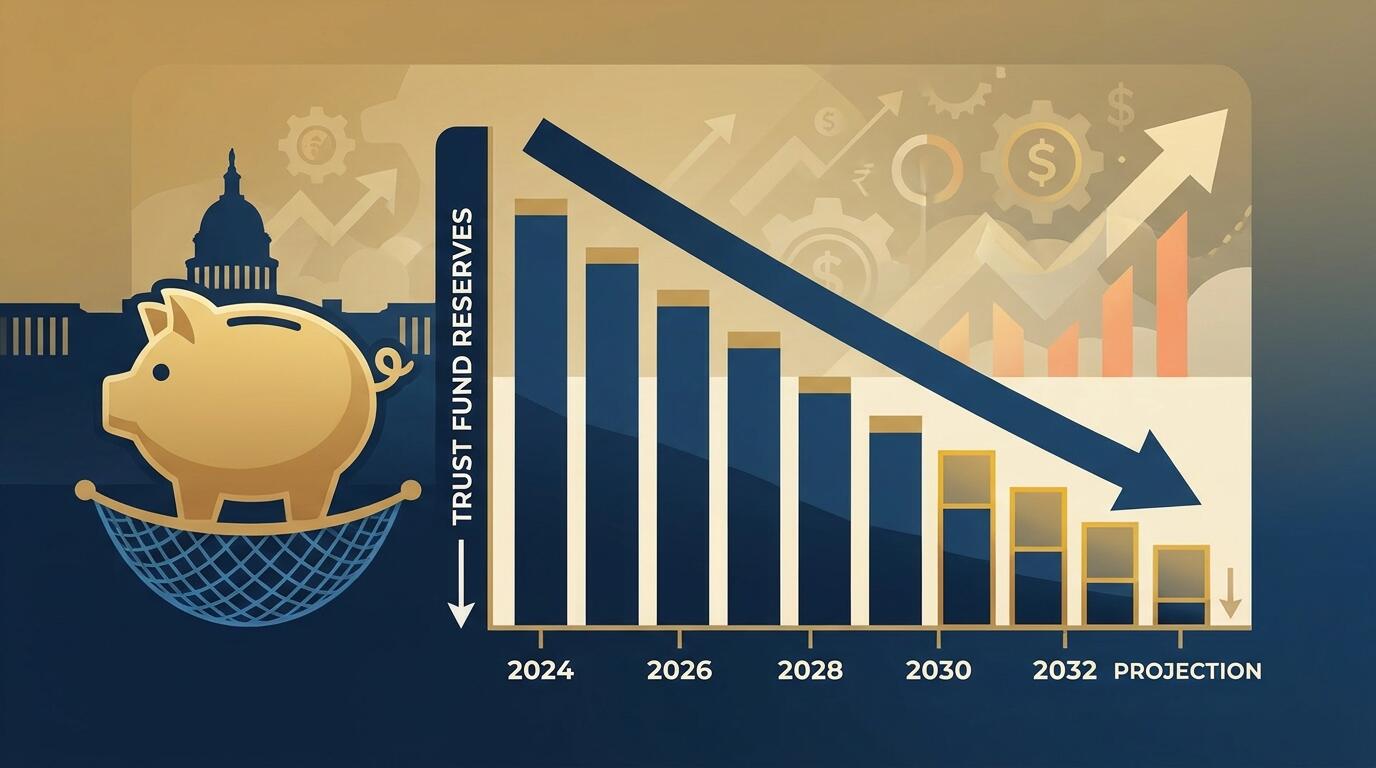
ALT: Social Security trust fund depletion timeline explained in plain English for everyday readers
What Does "Social Security Running Out" Actually Mean?
You're scrolling through the news and see a headline: "Social Security Trust Fund to Run Dry." Your stomach drops. You've been paying into this system your entire working life, and now you're wondering whether there will be anything left when you retire. It's a fear that crosses generational lines — whether you're 28 and just starting out or 44 and watching retirement inch closer.
The short answer from officials is this: Social Security is not going to disappear, but it does face a serious and well-documented financial shortfall that demands urgent attention. The distinction matters enormously, because "running out" implies zero — and that's not what the data shows. What officials are actually describing is a future gap between income and promised benefits, not a full collapse of the program. Understanding exactly what they mean, and what they're proposing to do about it, is the difference between panic and informed concern.
Who This Explanation Is For — and What It Won't Cover
Applicable Scenarios:
Workers who pay Social Security payroll taxes and want to understand what they're owed
People approaching retirement who are trying to factor Social Security into their financial planning
Young professionals and students curious about the long-term fiscal health of a program that affects nearly every American
Anyone confused by news headlines that seem to contradict one another on this topic
Not Applicable/Cautions:
This article does not constitute financial or retirement planning advice of any kind
This is not an analysis of individual Social Security benefit eligibility or projected personal payouts — those depend on personal work history and are governed by the Social Security Administration
The Background: How Social Security Is Funded and Why the Alarm Bells Started Ringing
Social Security is a federal insurance program, established in 1935, that provides retirement, disability, and survivor benefits to eligible Americans. It is funded primarily through payroll taxes — specifically the Federal Insurance Contributions Act (FICA) tax, which deducts a percentage from workers' paychecks and matches it with a contribution from employers. Those funds are deposited into two trust funds: the Old-Age and Survivors Insurance (OASI) Trust Fund and the Disability Insurance (DI) Trust Fund.
For decades, the system worked with a built-in cushion: more money was coming in from workers than was going out in benefits. The surplus accumulated in the trust funds as government-backed bonds. But the math started shifting in the 2010s, driven by two structural forces that the Social Security Board of Trustees has flagged in its annual reports for years.
First, the baby boom generation — roughly 76 million Americans born between 1946 and 1964 — began reaching retirement age, swelling the ranks of beneficiaries. Second, birth rates slowed in subsequent generations, meaning there are fewer younger workers relative to retirees to keep the payroll tax revenue flowing at the same pace. Think of it as a classic demographic squeeze: a larger group collecting benefits supported by a proportionally smaller group of contributors.
The result is that the trust funds are now drawing down their reserves to cover the gap between incoming taxes and outgoing benefits. The Social Security Board of Trustees, which publishes an annual report on the program's financial condition, has consistently projected that this drawdown will exhaust the combined trust fund reserves within the next decade or so — the exact year shifts slightly based on economic assumptions, but the trend has been a reliable feature of official reports for years.
It is worth noting that Social Security does not operate in isolation from broader fiscal pressures. As the Congressional Budget Office and the International Monetary Fund have both highlighted in recent analyses, aging-population challenges are creating budget pressures across many developed economies — a structural issue that goes well beyond any single program.
ALT: Chart showing Social Security trust fund reserve depletion timeline based on official trustee projections and Congressional Budget Office data
Step 1: Read the Actual Trustee Report, Not Just the Headline
The Social Security Board of Trustees publishes a detailed annual report, reviewed by the program's actuaries, that lays out the financial state of the trust funds with considerable precision. This is the primary official document on the subject, and it is publicly available through the Social Security Administration.
The key figure most headlines latch onto is the "depletion date" — the projected year when trust fund reserves would be fully exhausted. What those headlines frequently omit is the sentence that immediately follows in every official report: even after that date, Social Security would still be collecting payroll tax revenue, and that ongoing revenue would cover a significant share of scheduled benefits. According to the Social Security Board of Trustees, once reserves are depleted, ongoing tax income is projected to be sufficient to cover roughly three-quarters of scheduled benefits without any legislative changes. That means a benefit cut, not a benefit elimination.
That distinction is not meant to minimize the problem. A meaningful reduction in benefits for tens of millions of retirees would be a genuine hardship — and avoiding it requires policy action. But "three-quarters of benefits still paid" is a materially different scenario than "Social Security goes dark."
Step 2: Understand What the Congressional Budget Office Adds to the Picture
The Congressional Budget Office (CBO) conducts its own independent analysis of Social Security's long-term finances, separate from the Trustees' report, using its own economic and demographic models. The CBO's projections tend to run on a slightly different timeline than the Trustees', reflecting different assumptions about wage growth, inflation, and longevity — but they reach the same fundamental conclusion: the trust fund faces a structural shortfall that grows over time without legislative intervention.
The CBO also regularly publishes analyses of potential policy options to address the shortfall, which range from raising the payroll tax rate, to increasing the earnings cap subject to Social Security taxes, to adjusting the benefit formula, to raising the full retirement age. None of these options is painless, and the CBO's role is not to recommend but to score — meaning it estimates the budgetary impact of each approach without endorsing any of them. This is the toolkit that lawmakers are actually working from when they discuss "fixing" Social Security.
Step 3: Track What Lawmakers and the Administration Are Signaling
Political statements about Social Security tend to span a wide spectrum, and interpreting them requires some context. On one end, some elected officials have called for benefit cuts as part of broader deficit-reduction efforts. On the other end, others have proposed eliminating or raising the cap on earnings subject to payroll taxes — currently, wages above a certain threshold are not taxed for Social Security purposes — as a revenue-side fix.
In recent years, bipartisan concern about the program's solvency has grown more public, even as formal legislative solutions have remained elusive. Social Security has historically been described in Washington as the "third rail" of politics — touch it and you lose — which helps explain why, despite decades of official warnings, the policy response has been limited. The most recent major legislative reform of Social Security occurred in 1983, under a bipartisan commission led by Alan Greenspan, which included a mix of tax increases and benefit adjustments.
Officials across administrations have consistently said that Social Security benefits will be protected, but the mechanism for doing so — and the distribution of any burden — remains actively contested. For a closer look at how related cost-of-living benefit adjustments are being handled in the near term, Social Security's 2027 COLA explained for retirees breaks down what beneficiaries can expect in the coming years.
Comparing the Main Policy Options Discussed by Officials
When lawmakers and economists talk about restoring Social Security's long-term solvency, they are generally working from a menu of options that fall into two categories: increasing revenue or reducing costs. No single option is universally favored, and most serious proposals combine elements of both. The table below compares the three most frequently cited approaches based on publicly available official analyses.
Comparison Dimension — Raise Payroll Tax Rate — Lift or Remove Earnings Cap — Adjust Benefit Formula or Retirement Age
Primary Effect — Increases revenue from all workers — Increases revenue from higher earners — Reduces total outflow over time
Who Bears the Cost — All workers and employers — Higher-income workers and employers — Future beneficiaries, particularly younger cohorts
Political Reception — Broadly opposed; affects every paycheck — Mixed; popular with some, opposed by others — Highly contentious; often politically toxic
Estimated Solvency Impact — Significant, depending on the rate increase — Substantial, particularly if cap is fully removed — Substantial, though depends on the specific change
Distributional Concern — Regressive if applied uniformly — Progressive, shifts burden to high earners — May disproportionately affect lower-income retirees
Note: All estimates are general characterizations based on publicly available analyses from the Congressional Budget Office and Social Security Board of Trustees. Specific figures depend on legislative details.
Why the Framing of "Running Out" Is Both Accurate and Misleading
The phrase "Social Security running out" is accurate in a narrow technical sense: the trust fund reserves are being drawn down and will eventually reach zero under current projections. But it is misleading in the way most people interpret it — as meaning the program ends and benefits stop entirely.
Social Security is not a savings account. It is not a lockbox where your contributions sit waiting for you. It is an ongoing transfer program: today's workers pay taxes that fund today's retirees' benefits. As long as there are working Americans paying payroll taxes — which is essentially always — there will be Social Security revenue. The question is whether that revenue is enough to pay full promised benefits. Right now, projected over the long term, it is not. But it is enough to pay a substantial share.
This is the framing that officials from the Social Security Administration, the Congressional Budget Office, and independent policy analysts have consistently used. The gap is real. The urgency is real. But the apocalyptic framing that sometimes dominates headlines serves neither accuracy nor productive public understanding.
It is also worth noting that Social Security's fiscal challenges exist within a broader context of government budget pressures. The same demographic and fiscal dynamics driving the Social Security shortfall are contributing to wider deficit concerns that institutions like the IMF have flagged — and that directly affect how policymakers can realistically address the gap. The fiscal headroom available to Congress for a pure revenue-side fix is itself constrained by broader budget realities, which is why Social Security reform is so politically and economically complicated.
For context on how macroeconomic conditions and government spending interact with programs like Social Security, the IMF's warnings about budget deficits not seen since Covid offers useful background on the fiscal environment lawmakers are navigating.
Common Misconceptions and What Officials Actually Clarify
Several persistent misconceptions cloud public understanding of this issue, and officials — from the SSA, the CBO, and various nonpartisan policy bodies — have addressed them repeatedly.
Misconception 1: Social Security will simply cease to exist. Official projections do not support this. Even without legislative changes, payroll tax revenues continue flowing into the program. What changes after a trust fund depletion date is the benefit level, not the program's existence.
Misconception 2: Your Social Security contributions are sitting in a personal account. They are not. Social Security is a pay-as-you-go system, meaning current workers' taxes fund current retirees' benefits. Any surplus has historically been invested in special U.S. Treasury securities — government bonds — not held in individual accounts.
Misconception 3: Raising the retirement age is a purely neutral, actuarial fix. Officials and policy analysts note that increasing the full retirement age functions effectively as a benefit cut, particularly for workers in physically demanding jobs who may not be able to extend their careers and for lower-income workers with shorter life expectancies.
Misconception 4: Congress will simply let the program fail. No Congress has allowed Social Security to actually default on benefits in the program's nearly 90-year history. The political cost of doing so would be extraordinary. However, the track record of procrastination is real — and the longer a fix is delayed, the more abrupt any adjustment would need to be.
Q1: How much would Social Security benefits actually be reduced if the trust fund runs out?
According to the Social Security Board of Trustees' official projections, if no legislative action is taken and the trust fund reserves are depleted, ongoing payroll tax revenues are projected to cover roughly 75 to 80 percent of scheduled benefits at that point. That means a benefit reduction in that range — not a complete elimination of payments. The exact percentage varies depending on the year's economic assumptions, but this consistent range is the figure officially cited by the SSA and corroborated by Congressional Budget Office analyses.
Q2: Is it true that higher-income workers could be asked to pay more into Social Security?
This is one of the most widely discussed policy options. Currently, Social Security payroll taxes apply only to wages up to a certain threshold — above that cap, additional earnings are not subject to the tax. Several legislative proposals have called for eliminating or raising this cap so that higher earners contribute proportionally more, which official CBO analyses suggest would significantly improve the program's long-term finances. However, this remains a legislative debate, not a decided policy.
Q3: When do officials say the Social Security trust fund is projected to be depleted?
The projected depletion date shifts somewhat from year to year based on updated economic and demographic assumptions, but official Trustees' reports and CBO analyses have consistently placed the combined trust fund depletion within roughly the next decade under current law. The most important thing to understand is that "depletion" refers to the reserves — not to the program ending. After that date, ongoing payroll taxes would continue funding a significant portion of benefits. The specific year in any given report reflects the economic conditions assumed at the time of writing, so checking the most recent official Trustees' report provides the current best estimate.
Final Thoughts
The headlines about Social Security "running out" are not wrong, but they are routinely incomplete — and that incompleteness generates more fear than understanding. Here is what the official record actually shows:
Social Security faces a real and documented financial shortfall, driven by demographic change and a growing imbalance between contributors and beneficiaries.
The trust fund reserves are being drawn down and, under current projections, will be exhausted within roughly the next decade without legislative action.
After depletion, ongoing payroll tax revenues would still cover a substantial share of promised benefits — a significant cut, but not a zero.
A range of policy solutions exists, each involving trade-offs between workers, employers, higher earners, and future retirees. None is without political or economic cost.
No U.S. Congress has ever allowed Social Security to default on benefits, but the window for a gradual, less disruptive fix narrows with every year that action is delayed.
The most productive thing you can do with this information is understand the actual risk — a potential future benefit reduction — and factor that qualitatively into how you think about your broader financial picture. Whether that prompts any changes in your own approach is a personal decision, best made with the guidance of a qualified advisor.
Want to make sense of today's financial headlines without the jargon? Visit Vega Brief for plain-English explainers on the economic stories that matter most — from Social Security to market moves to personal finance news, all backed by cited sources and written strictly for your education. Bookmark Vega Brief and turn financial confusion into confident understanding, one story at a time.
Sources
Social Security Administration — Board of Trustees. "Annual Report of the Board of Trustees of the Federal Old-Age and Survivors Insurance and Federal Disability Insurance Trust Funds."
https://www.ssa.gov
Congressional Budget Office. "Long-Term Budget Outlook and Social Security Financial Projections."
https://www.cbo.gov
International Monetary Fund. "Fiscal Monitor: Aging Populations and Long-Term Fiscal Sustainability."
https://www.imf.org
Note: Government reports and projections are updated periodically; please check the latest official publications from the Social Security Administration and Congressional Budget Office for current figures and revised timelines.
For educational purposes only. Not investment advice. We do not recommend any stock, fund, broker or trading platform. Headlines are sourced from Google News · Business; every story links to the original publishers.