What Rising Bond Yields Mean for Stock Market Volatility Right Now
ALT: Rising bond yields creating stock market volatility — what investors need to understand right now
For educational purposes only. Not investment advice.
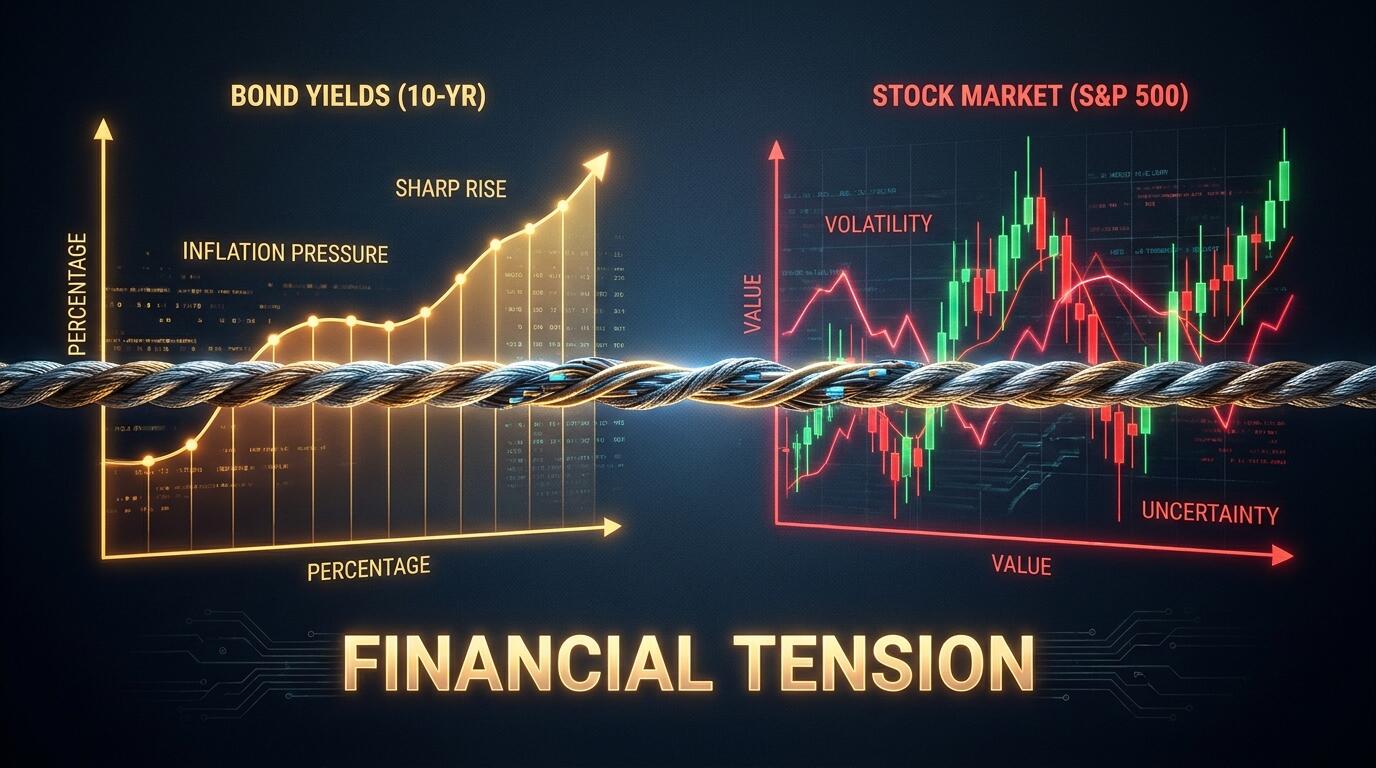
ALT: Rising bond yields creating stock market volatility — what investors need to understand right now
Bond Yields vs. Stock Prices: Understanding the Tug-of-War Driving Market Volatility
When bond yields rise sharply, stock markets tend to get nervous — and right now, that relationship is front and center in financial news. Rising bond yields signal higher borrowing costs across the economy, which puts pressure on corporate profits, consumer spending, and the relative attractiveness of owning stocks. The result is often increased volatility in equity markets, as investors recalibrate what companies are actually worth in a higher-rate world.
This article compares the two dominant forces at play: rising bond yields (representing the fixed-income market's growing pull on capital) and equity market stability (the status quo that higher yields tend to disrupt). We evaluate these forces across criteria that matter to everyday readers — including what each means for the cost of money, corporate earnings, investor behavior, and your broader financial picture. The goal is not to tell you what to do with your money, but to help you understand what's happening and why it keeps making headlines.
What Makes This Comparison Worth Understanding
To make sense of the bond yield versus stock market stability debate, it helps to evaluate the relationship through several practical lenses. These are the dimensions that financial journalists, economists, and market analysts consistently return to when explaining why yields matter — and a pattern we see repeatedly in the financial news cycle at Vega Brief.
The cost of borrowing. Bond yields function as a benchmark for interest rates across the economy. When yields on government bonds rise, borrowing becomes more expensive for businesses, homebuyers, and governments alike. This criterion matters because it directly affects corporate investment plans and consumer spending — two major drivers of economic growth.
Corporate earnings expectations. Higher borrowing costs compress profit margins, especially for companies carrying significant debt. Analysts use a concept called the "discount rate" to estimate what future profits are worth in today's dollars. When that rate rises — as it does when bond yields climb — future earnings look less valuable, which can justify lower stock prices even if underlying business performance hasn't changed.
The risk-reward calculation. Stocks are inherently riskier than government bonds. When bonds offer meaningfully higher yields, some investors — particularly institutional ones managing enormous pools of capital — may shift money out of equities and into bonds. This capital rotation can accelerate stock market sell-offs.
Investor sentiment and market psychology. Volatility is as much about emotion as it is about math. Rising yields can trigger uncertainty about where the economy is headed — are they rising because growth is strong, or because inflation is sticky and the Federal Reserve is keeping rates high? That ambiguity breeds volatility.
Macroeconomic context. Not all yield increases are created equal. A gradual rise in yields during a healthy expansion is very different from a rapid spike during a period of economic stress. The pace, magnitude, and cause of yield movements all shape how much disruption filters through to equity markets.
Duration and magnitude of the move. Short-term yield spikes may rattle markets briefly before calm returns. Sustained, elevated yields over months reshape corporate strategies, hiring plans, and consumer behavior in more lasting ways. Understanding how long yields stay elevated helps frame the likely depth and duration of equity market volatility.
Rising Bond Yields — The Disruptor
A bond yield is the annual return an investor earns by holding a bond to maturity, expressed as a percentage of the bond's price. When investors sell bonds (pushing prices down), yields rise — and vice versa. Government bond yields, particularly those on U.S. Treasury securities, serve as a foundational benchmark for pricing financial assets across the global economy.
Bond yields rise for several reasons: the Federal Reserve keeps its benchmark interest rate elevated; inflation remains stubborn; or investors demand higher compensation for the risk of holding long-term debt, a phenomenon known as the "term premium." According to the U.S. Department of the Treasury, which publishes daily yield data on securities of varying maturities, the yield curve — the line connecting short-term to long-term rates — is one of the most-watched indicators in all of finance.
When yields climb, the effect ripples outward quickly. Mortgage rates follow (as Federal Reserve rate decisions directly shape borrowing costs for mortgages and savings accounts). Corporate bond markets reprice. Growth-oriented technology companies — whose valuations rely heavily on the promise of future earnings — tend to feel the squeeze most acutely. The disruptive force of rising yields lies not just in their absolute level, but in the speed and unexpectedness of the move.
Stock Market Stability — The Status Quo Under Pressure
Stock market stability, in this context, refers to the conditions under which equity prices move in relatively orderly ranges — grounded in predictable earnings growth, manageable borrowing costs, and clear signals from central banks. Stability is not the absence of movement; markets always fluctuate. Rather, it describes a state where volatility is low enough that long-term investors feel confident allocating capital to equities.
The equity market's stability is undermined when the assumptions underpinning stock valuations shift. For decades, many market participants operated under the assumption that bond yields would remain relatively low — a legacy of post-financial-crisis monetary policy. That assumption is now being tested. As yields trend higher and stay there, the mental model investors use to price stocks has to be rebuilt, and that rebuilding process is inherently volatile.
Equity market volatility is commonly measured by the CBOE Volatility Index (VIX), often called the "fear gauge," which reflects the market's expectations for near-term price swings in the S&P 500. When yields spike, VIX readings tend to climb alongside them — not always immediately, but consistently enough that the correlation between rising yields and elevated market volatility has become a staple of market analysis.
Head-to-Head: How Rising Yields Stack Up Against Market Stability Conditions
Criterion — Rising Bond Yield Environment — Stable / Low-Yield Environment
Cost of borrowing — High — raises costs for businesses and consumers — Low — cheap credit supports corporate expansion
Corporate earnings impact — Negative — compresses margins, reduces present value of future profits — Positive — lower debt service costs support profits
Investor capital flows — Toward bonds, away from equities — Toward equities, away from low-yield bonds
Market volatility (VIX) — Tends to rise, especially with rapid yield moves — Tends to remain lower, with less repricing pressure
Growth stock performance — Underperforms — higher discount rates hit hardest — Outperforms — future earnings valued more generously
Value/dividend stock performance — Mixed — some benefit from income focus, others hurt by rate sensitivity — Mixed — less relative advantage when bonds offer little yield
Economic growth signal — Ambiguous — could mean strong growth or persistent inflation — Ambiguous — could mean healthy expansion or stagnation
Housing market impact — Negative — mortgage rates rise, slowing home purchases — Positive — lower mortgage rates support housing activity
The table above makes one thing clear: a rising yield environment and equity market stability are, in important ways, fundamentally in tension. That tension is not always resolved quickly, and in our work covering financial news at Vega Brief, it's a pattern we consistently see misunderstood in popular coverage — with headlines often treating every yield move as either catastrophic or meaningless, when the reality is more nuanced.
What the table doesn't capture is the pace dimension. A gradual rise in bond yields, accompanied by strong economic data suggesting robust growth, can be absorbed by equity markets with relatively modest volatility. It is the rapid, unexpected spike in yields — often triggered by a surprise inflation report, a fiscal policy announcement, or a shift in central bank communication — that causes sharper equity sell-offs and VIX spikes.
It's also worth noting that the relationship between yields and stocks isn't perfectly inverse. Sectors like financials — banks and insurance companies, for example — can actually benefit from higher yields because they earn more on their lending activities. Energy companies and commodity producers may also hold up well if rising yields are associated with a booming economy. The disruption is most severe for highly indebted growth companies and interest-rate-sensitive sectors like utilities and real estate investment trusts (REITs).
The International Monetary Fund's warnings about budget deficits add another layer: when governments run large deficits, they must issue more bonds to finance their spending, which can put upward pressure on yields over time. Larger debt supply without a corresponding increase in buyer demand tends to push bond prices down and yields up — a dynamic with real consequences for equity market stability.
Which Scenario Should You Be Paying Attention To Right Now?
Understanding where you stand relative to these dynamics helps frame why the news matters to you personally — even if you're not actively trading stocks.
If you're a young professional building an investment portfolio for the long term, rising yields are worth understanding but shouldn't necessarily change your long-term strategy. Market volatility driven by yield movements is a normal part of economic cycles. What matters more is recognizing that the conditions shaping stock valuations have shifted, and that patience tends to outperform panic during periods of repricing.
If you're watching the housing market or considering a mortgage, rising bond yields have a direct and immediate impact. Mortgage rates are benchmarked to long-term Treasury yields, and when those yields climb, so do the rates lenders charge. Understanding this connection helps explain why home affordability has tightened meaningfully in recent cycles.
If you're trying to understand financial news headlines about market sell-offs, the yield-to-equity relationship is one of the most reliable explanatory frameworks. When you see "stocks fell as Treasury yields climbed," that's the mechanism in action. The 10-year Treasury yield is the most commonly referenced benchmark — it reflects the market's expectations for long-term growth and inflation, and its movements have outsized influence on stock valuations.
If you're curious about global economic trends, it's worth knowing that U.S. Treasury yields don't exist in isolation. As one analyst framework recognizes, economists closely track bond market dynamics in major economies — including Europe — because they signal shifts in global capital flows, growth expectations, and central bank policy trajectories. Why economists are watching Europe's bond markets this year is a directly related question, because yield movements in major economies often reinforce or counteract each other in ways that affect global equity volatility.
Pros of understanding the rising yield environment:
Helps explain why stock markets feel unsettled even when economic data looks decent
Provides context for mortgage rate trends, savings account yields, and bond fund performance
Frames the Federal Reserve's role more clearly — rate decisions ripple directly into Treasury yields
Equips you to evaluate financial news with more critical thinking and less reactive emotion
Cons of the current environment for equity markets:
Elevated volatility makes portfolios harder to watch without anxiety
Growth-oriented stocks face genuine, mathematically grounded headwinds
The end point of the yield cycle is uncertain — timing it is notoriously difficult even for professionals
ALT: Chart illustrating relationship between rising Treasury bond yields and stock market volatility for financial education
How do rising bond yields actually cause stock prices to fall?
Rising bond yields cause stock prices to fall through two main channels. First, when bonds offer higher returns, some investors move capital out of stocks and into bonds — reducing demand for equities and pushing prices down. Second, higher yields increase the "discount rate" used to calculate the present value of a company's future profits, making those future earnings worth less in today's dollars. Growth stocks — whose value depends most on distant future earnings — tend to fall hardest.
Are rising bond yields always bad for the stock market?
Rising bond yields are not always bad for the stock market. When yields rise because the economy is growing strongly and generating healthy inflation, corporate earnings may hold up well enough to offset the pressure from higher discount rates. The damage tends to be worst when yields spike rapidly and unexpectedly, catch investors off guard, or rise because inflation is proving stubbornly difficult for central banks to control. The cause and pace of yield increases matter as much as the level.
How long do periods of high bond yield-driven market volatility typically last?
The duration of bond yield-driven market volatility depends heavily on central bank policy, inflation trends, and economic growth. Historically, as documented by the Federal Reserve and academic finance research, yield-driven equity disruptions can last months to years when central banks are in sustained tightening cycles, and may resolve more quickly when inflationary pressures ease and rate expectations stabilize. There is no fixed timeline — which is why monitoring economic indicators and understanding the underlying drivers matters more than watching short-term price moves.
Wrapping Up
The relationship between rising bond yields and stock market volatility is one of the most fundamental dynamics in modern financial markets — and one of the most frequently misunderstood in everyday news consumption.
Three key points are worth carrying away from this discussion. First, bond yields and stock valuations are mathematically connected through the discount rate — when yields rise, the present value of future corporate earnings falls, which puts genuine downward pressure on stock prices. This is not opinion; it is a core principle of financial mathematics. Second, not all yield increases are equally disruptive. The speed, magnitude, and cause of a yield move determines how much volatility filters into equity markets, which means context is everything when interpreting financial headlines. Third, the effects extend well beyond Wall Street — rising yields influence mortgage rates, consumer borrowing costs, government debt financing, and global capital flows in ways that touch everyday financial life.
Understanding these connections doesn't require a finance degree. It requires a clear framework, honest sources, and plain-English explanations — which is exactly the kind of educational coverage financial news needs more of.
For your next step: the next time a headline tells you "stocks fell as bond yields rose," you'll have the vocabulary and the framework to understand exactly what's happening — and why it matters to you.
Want to understand the financial headlines that actually affect your life, without the jargon and noise? Visit Vega Brief for AI-assisted, plain-English explainers on bond markets, interest rates, stock volatility, and every other economic story making the news — all source-linked and strictly educational, so you can stay informed and think for yourself.
Sources
U.S. Department of the Treasury. "Daily Treasury Yield Curve Rates."
https://www.treasury.gov
Federal Reserve. "Monetary Policy and Interest Rates — Educational Resources."
https://www.federalreserve.gov
International Monetary Fund. "Global Financial Stability Reports and Fiscal Monitor."
https://www.imf.org
U.S. Securities and Exchange Commission. "Bonds and Fixed Income — Investor Education."
https://www.sec.gov
Cboe Global Markets. "CBOE Volatility Index (VIX) — Methodology and Data."
https://www.cboe.com
Note: Economic data and market conditions change frequently. Always check the latest official publications or consult qualified financial professionals for current information.
For educational purposes only. Not investment advice. We do not recommend any stock, fund, broker or trading platform. Headlines are sourced from Google News · Business; every story links to the original publishers.