What 'Default Risk' Really Means: A Plain-English Guide to Sovereign Bonds
ALT: Plain-English guide explaining sovereign bond default risk and government debt concepts for everyday readers
For educational purposes only. Not investment advice.
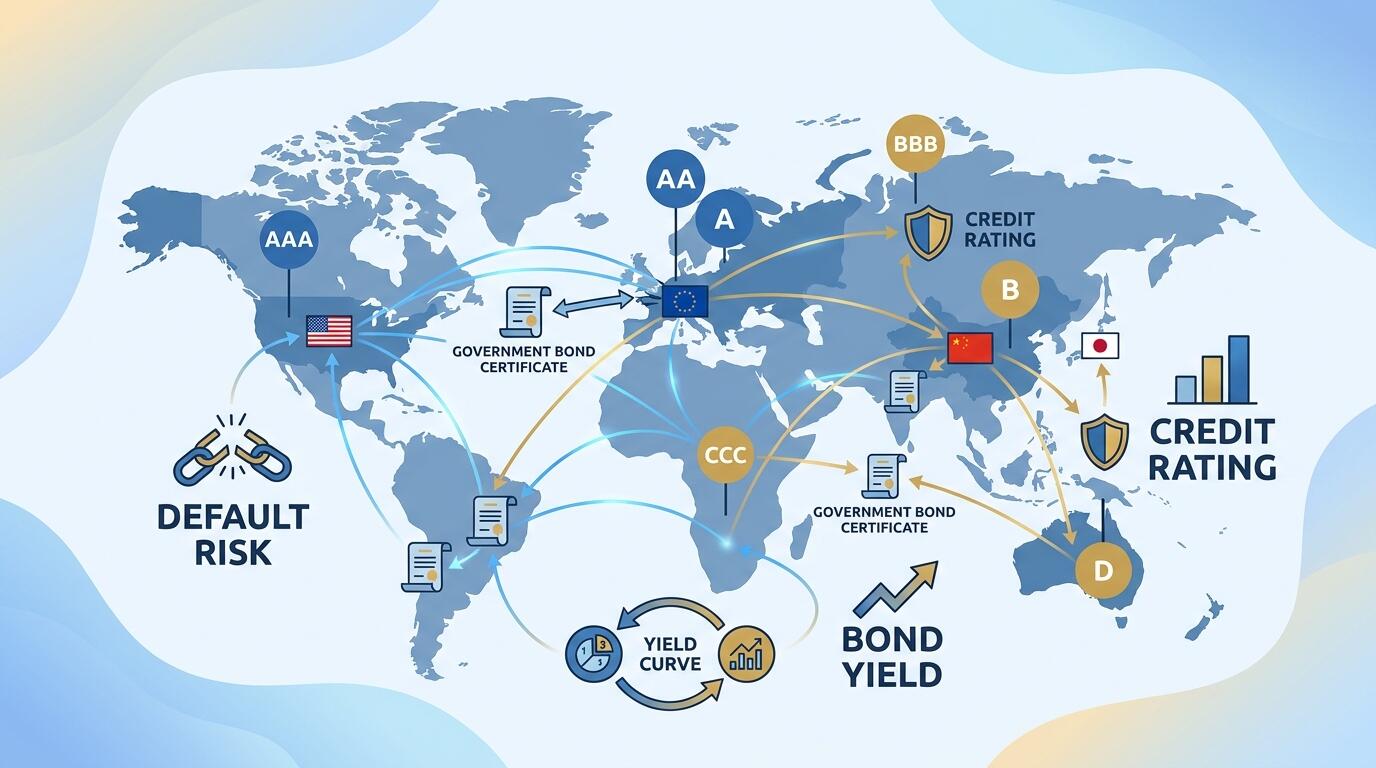
ALT: Plain-English guide explaining sovereign bond default risk and government debt concepts for everyday readers
What You'll Understand After Reading This Guide to Sovereign Bond Default Risk
Key Conclusion: Sovereign bond default risk is the possibility that a national government will fail to repay its debt on time or in full. This guide explains what that means in plain English, how credit ratings and bond yields signal that risk, why it matters to everyday people — not just Wall Street traders — and how to read financial headlines about government debt without needing a finance degree. By the end, you will have a clear, working understanding of one of the most consequential concepts in global economics.
Government debt headlines can feel impenetrable. Words like "sovereign default," "yield spreads," and "credit downgrade" appear in news alerts and economic reports without any accompanying explanation. This guide is written for anyone who wants to understand what those terms actually mean, why they matter, and how the risk of a government failing to pay its debts ripples through the economy in ways that affect mortgages, savings, and everyday prices.
Before You Start: What Helps to Know in Advance
You do not need a background in finance or economics to follow this guide. The concepts are explained from the ground up. That said, a few pieces of foundational knowledge will make everything click faster.
It helps to have a basic sense of what a bond is. A bond is a loan in the form of a security: a borrower issues it, promising to repay the loan amount (called the principal) at a set future date and to pay regular interest (called the coupon) along the way. Governments issue bonds to finance spending when tax revenues fall short. When a government sells a bond to an investor — whether that investor is a pension fund, a foreign central bank, or an individual — the government is essentially saying, "Lend us money now, and we will pay you back later, with interest."
It also helps to understand that risk and reward are linked in financial markets. When an investment carries more risk, investors typically demand a higher return to compensate. That relationship is central to understanding why default risk drives bond yields up or down.
Finally, knowing that governments are rated — like a credit score, but for countries — by independent agencies gives you a useful frame. These ratings are published assessments of how likely a government is to meet its debt obligations.
Before moving forward, it is worth confirming you are comfortable with these ideas:
You understand that borrowing involves a promise to repay
You know that interest rates compensate lenders for taking on risk
You are familiar with the concept that news about government debt can affect financial markets broadly
The guide is designed to be read in one sitting. Each section builds on the last, so reading in order will produce the clearest understanding.
Step 1: Define What a Sovereign Bond Actually Is
A sovereign bond is a debt instrument issued by a national government to raise money from investors. The word "sovereign" refers to the issuing authority — a nation-state — rather than a corporation or a local government. When you hear that a country has "gone to the bond market," it means the government sold these instruments to raise funds.
Sovereign bonds come in many forms. Some are short-term (maturing in months), while others are long-term (maturing in decades). The United States issues Treasury bonds, notes, and bills. Germany issues Bunds. The United Kingdom issues Gilts. Japan issues Japanese Government Bonds. Each carries the full faith and credit of the issuing government, which is why they are often described as the safest investments in their respective countries.
Tip: The phrase "full faith and credit" sounds reassuring — and usually is — but it is not an absolute guarantee. History shows that even governments default. Understanding when and why that happens is the whole point of this guide.
Step 2: Understand What "Default" Means in This Context
Default, in the context of sovereign bonds, means a government fails to meet its debt obligations as promised. This can take two forms. A hard default occurs when a government simply stops making payments — it does not pay interest on schedule, or it does not repay the principal when the bond matures. A soft default, sometimes called a restructuring, occurs when the government renegotiates the terms of the debt — extending the repayment timeline, reducing the interest rate, or accepting a "haircut" (a reduction in the face value of what is owed).
According to research published by the American Economic Association, sovereign debt defaults are not rare historical anomalies. They recur across economic cycles and tend to cluster during periods of currency crises, commodity price collapses, or global financial stress. Argentina has restructured its debt multiple times. Greece underwent a significant restructuring in 2012. Russia defaulted in 1998. These are not footnotes in financial history — they had broad economic consequences for the countries involved and, in some cases, for global markets.
The key distinction from corporate default is this: a government cannot simply be liquidated. There is no court that can seize a country's assets the way a bankruptcy court can seize a company's. That makes sovereign debt enforcement uniquely complicated and sovereign default uniquely disruptive.
Tip: When reading news about a country's debt crisis, look for whether journalists are describing a "hard default" or a "restructuring." The distinction matters enormously for investors and for the broader economy of the country involved.
Step 3: Learn How Credit Ratings Signal Default Risk
Credit rating agencies are organizations that assess the likelihood of a borrower — including a sovereign government — failing to repay its debt. The three most prominent internationally recognized agencies are Moody's, Standard & Poor's (S&P), and Fitch. Each publishes ratings using letter-based scales that run from the highest quality (indicating minimal default risk) down to ratings that indicate imminent or actual default.
On the S&P scale, for example, ratings from AAA down to BBB- are considered "investment grade" — meaning the risk of default is judged to be relatively low. Ratings below that threshold are commonly called "speculative grade" or, more colloquially, "junk." A country whose bonds are rated in junk territory will generally have to pay significantly higher interest rates to attract investors, because the risk of non-payment is judged to be substantially higher.
A rating downgrade — when an agency lowers a country's credit rating — is one of the most closely watched events in financial markets. It signals that professional analysts have assessed the government's fiscal position and concluded that the risk of default has increased. Even a downgrade from AA to AA- can trigger market volatility, because it affects the interest rates at which the country can borrow and influences whether certain institutional investors (like pension funds, which have rules about holding only investment-grade debt) are permitted to hold the bonds.
Tip: Credit ratings are opinions, not guarantees. They can be wrong, and they can lag behind market conditions. Sophisticated investors also look at bond yield spreads (discussed in the next step) as a real-time market signal that often moves faster than formal ratings changes.
Step 4: Read the Yield Spread as a Market Thermometer
The yield spread is one of the most important real-time indicators of sovereign default risk, and it is also one of the most misunderstood. A bond's yield is the effective annual return an investor earns if they hold the bond to maturity — it moves inversely to the bond's price. When investors become nervous about a government's ability to repay, they sell that government's bonds, prices fall, and yields rise.
The spread is the difference between one country's bond yield and a benchmark yield — typically the yield on U.S. Treasury bonds or German Bunds, which are considered among the safest in the world. If a country's ten-year bond yields 8% while U.S. ten-year Treasuries yield 4%, the spread is 4 percentage points (often expressed as 400 "basis points"). A wider spread signals greater perceived default risk. A narrowing spread signals improving confidence.
This concept connects directly to how the Federal Reserve's rate decisions affect borrowing costs across the entire financial system — because U.S. Treasury yields, which are heavily influenced by Federal Reserve policy, serve as the global benchmark against which sovereign spreads are measured. When base rates shift, the entire landscape of risk pricing shifts with them.
Tip: When a financial headline says a country's bonds are "selling off," it means yields are rising — which means default risk is being priced higher by the market. This is the market equivalent of people running for the exits.
ALT: Diagram comparing sovereign bond yield spreads across countries to illustrate default risk assessment and investment-grade ratings
Step 5: Understand Why Sovereign Default Risk Matters to Ordinary People
Sovereign bond default risk is not an abstract concern reserved for institutional investors. Its consequences ripple outward in ways that affect prices, employment, and financial stability for ordinary citizens.
When a government faces elevated default risk, its borrowing costs rise. Higher borrowing costs mean the government must spend more on debt service — the interest payments on its outstanding debt. That money has to come from somewhere: either higher taxes, reduced public spending, or additional borrowing. All three options carry economic and social costs.
Higher sovereign yields also push up borrowing costs across the broader economy. Banks use government bond yields as a reference rate for pricing loans. When sovereign yields rise, mortgage rates, business loan rates, and consumer credit rates tend to rise with them. This dynamic is one reason that debt crises in countries with large bond markets can quickly translate into housing market stress — an effect visible in discussions of how elevated mortgage rates are reshaping housing affordability even in economies not directly in crisis.
For investors — including anyone with a pension, a retirement account, or savings invested in a bond fund — sovereign default risk is also a direct financial concern. Many funds hold government bonds as a "safe" component of a diversified portfolio. A surprise downgrade or default can reduce the value of those holdings substantially.
Tip: Even if you have never bought a government bond directly, you are probably exposed to sovereign bond market dynamics through your pension, your bank, or the overall interest rate environment in your country.
Step 6: Identify the Key Factors That Drive Sovereign Default Risk Higher or Lower
Several measurable factors are consistently associated with elevated or reduced sovereign default risk. Understanding them makes it possible to evaluate financial news about government debt with more critical judgment.
Debt-to-GDP ratio is a widely used indicator. It expresses total government debt as a percentage of the country's annual economic output. A very high ratio does not automatically mean default is imminent — Japan, for example, carries a debt-to-GDP ratio far above most other developed economies without facing acute crisis — but it does signal that the debt burden is large relative to the country's capacity to generate revenue.
Primary fiscal balance refers to government revenues minus spending, excluding interest payments. A country running a primary surplus (taking in more than it spends before accounting for interest) is in a structurally better position to manage its debt than one running persistent deficits, because it is generating resources that can service the debt.
Foreign currency denomination is a crucial and often overlooked factor. A government that issues debt in its own currency retains the option — however economically damaging — of printing money to meet obligations. A government that issues debt in a foreign currency (say, U.S. dollars) does not have that option. This is one reason why emerging market defaults often involve foreign-currency debt: the government simply runs out of the foreign currency needed to make payments. Research accessible through Harvard Kennedy School's public finance resources highlights this distinction as a recurring structural vulnerability in sovereign debt crises.
External reserves — the foreign currency and gold holdings a central bank maintains — serve as a buffer. A country with substantial reserves can continue servicing foreign-currency debt even during periods of stress. Declining reserves are often a warning signal that a currency or debt crisis is approaching.
Political stability and institutional quality also matter. Markets assess not only whether a government has the economic capacity to repay debt, but whether it has the political will to do so. Governments that have defaulted before, or that face significant political instability, tend to be priced at higher yields.
Tip: No single indicator tells the full story. In our work explaining financial news, a pattern we consistently see is that defaults tend to follow a convergence of multiple risk factors — not one isolated variable. The countries that face acute crises are typically those where debt ratios, currency exposure, reserve depletion, and political dysfunction deteriorate simultaneously.
Step 7: Apply This Framework to Real Financial Headlines
The final step is practical: using this framework to decode the kind of sovereign bond news that appears regularly in financial media.
When you read "Country X's bond yields surged to a 10-year high," you now know that means investors are demanding higher compensation to hold that country's debt — a signal of rising default concern, falling bond prices, or both.
When you read "Rating agency Y downgraded Country X's sovereign debt to junk," you know that means professional credit analysts have concluded the probability of default has crossed a threshold that places it outside investment-grade territory — with likely consequences for the government's borrowing costs and for institutional investors who cannot hold below-investment-grade debt.
When you read "Country X reached a debt restructuring agreement with creditors," you know that is a soft default: the original terms of repayment have been renegotiated, meaning some investors are accepting less than they were originally promised.
Understanding these distinctions transforms financial news from opaque jargon into meaningful information — which is precisely what Vega Brief is built to help readers do across a wide range of economic and market topics.
Tip: Practice by picking one sovereign bond news story per week and identifying which of the concepts covered here apply. Over time, the framework becomes intuitive.
Common Mistakes & Troubleshooting When Reading Sovereign Bond News
Symptom — Likely Cause — How to Fix
Confusing a bond yield rising with the bond becoming more valuable — Misunderstanding the inverse relationship between bond prices and yields — Remember: when prices fall, yields rise. A surging yield is a sign of falling demand, not growing value
Assuming a high-debt country will definitely default — Conflating debt-to-GDP ratio with imminent default risk — Consider the full picture: currency denomination, reserves, fiscal balance, and political context all matter
Treating credit ratings as real-time market signals — Rating changes lag market moves and involve subjective judgment — Check yield spreads alongside ratings — markets often price in stress before agencies formally downgrade
Believing only developing countries default — Anchoring to historical examples from emerging markets — Developed economies have also restructured or defaulted; the risk is universal, though it varies by institutional strength
Assuming default only harms foreign investors — Underestimating the domestic economic consequences — Defaults raise borrowing costs economy-wide, can trigger banking crises, and frequently lead to austerity measures affecting ordinary citizens
Pro Tips for Better Results When Following Sovereign Debt Stories
Track the spread, not just the headline rate. Absolute yield levels are less informative than how a country's yield compares to a benchmark. A 5% yield means something very different for a country with a AAA rating versus one with a BB rating. The spread tells you how much extra return investors require for taking on the additional default risk.
Watch for IMF involvement as an early indicator. When the International Monetary Fund begins negotiations with a country over a loan program or debt sustainability assessment, it is a strong signal that markets and policymakers consider the sovereign's fiscal position to be under serious stress. IMF programs often come with conditions attached — fiscal reforms, spending cuts — that affect the broader economy.
Distinguish between liquidity problems and solvency problems. A liquidity problem means a government temporarily cannot access markets to roll over its debt — it may be creditworthy in the long run but facing a short-term cash crunch. A solvency problem means the debt is genuinely unsustainable relative to the country's economic capacity. Liquidity crises can often be resolved with emergency lending; solvency crises typically require restructuring. Financial news often conflates the two.
Pay attention to who holds the debt. A country whose debt is mostly held domestically (by its own banks and pension funds) faces different default dynamics than one whose debt is mostly held by foreign investors. A domestic default can trigger a banking crisis at home; a foreign-currency default cuts off access to international capital markets. The creditor composition shapes both the risk and the political feasibility of restructuring.
Common misconception to clear up: Many people assume that a government can always "just print money" to avoid default. This is only partially true, and only for governments that borrow in their own currency. Printing money to service debt devalues the currency and generates inflation — which is, in effect, a different kind of default on the real value of the debt. For governments that borrow in foreign currencies, printing domestic money provides no help at all. According to the U.S. Securities and Exchange Commission's investor education resources, bond investors — including sovereign bond holders — face both credit risk (default) and inflation risk, and the two are related in complex ways.
Q1: How do credit rating agencies determine a country's default risk?
Credit rating agencies like Moody's, S&P, and Fitch assess sovereign default risk by analyzing a country's economic strength (GDP growth, income levels), fiscal position (debt ratios, budget balance), institutional quality (governance, rule of law), and external vulnerabilities (foreign reserves, currency regime). They combine quantitative models with qualitative judgment calls. Ratings are reviewed periodically, though markets often move faster than agencies — yield spreads frequently widen before a formal downgrade is announced.
Q2: Are U.S. Treasury bonds completely free of default risk?
U.S. Treasury bonds are widely considered the safest sovereign debt instruments in the world, serving as the global benchmark for "risk-free" returns. However, "risk-free" in this context refers specifically to credit risk — the probability of non-payment. Treasuries are still subject to inflation risk (the real value of repayments can erode) and interest rate risk (rising rates reduce the market value of existing bonds). The U.S. investor education body, the SEC's Investor.gov, classifies bonds, including Treasuries, as carrying these distinct risk categories separately from default risk.
Q3: How long does it typically take for a country to recover access to bond markets after a default?
Recovery timelines vary considerably depending on the severity of the restructuring, the political response, and global market conditions — making a single answer impossible. Some countries have returned to bond markets relatively quickly after restructuring (within a few years) when they implemented credible fiscal reforms and benefited from favorable global conditions. Others have faced prolonged exclusion. Research by the American Economic Association documents that the economic costs of sovereign defaults persist beyond the restructuring itself, affecting growth, borrowing costs, and investment for years afterward.
Summary
Sovereign bond default risk is the probability that a national government will fail to meet its debt obligations — whether through an outright payment failure or a renegotiation of terms. Understanding this concept is not just useful for investors; it is essential for anyone trying to make sense of economic news.
Key Takeaways:
A sovereign bond is a loan to a national government, and default risk is the chance that loan goes unpaid or is restructured on worse terms
Credit ratings provide a periodic professional assessment of default risk, but bond yield spreads offer a real-time market signal that often moves first
Default risk rises when debt ratios are high, reserves are falling, foreign-currency debt is large, and political stability is weak — rarely from a single factor alone
Sovereign defaults have direct consequences for ordinary people through higher borrowing costs, reduced public services, banking sector stress, and currency depreciation
"Risk-free" is a relative term — even the most creditworthy government bonds carry inflation and interest-rate risk distinct from default risk
The next step is to start applying this framework when you encounter sovereign debt news. Pick a current story about a government's fiscal position and identify which concepts apply. You will find that the same vocabulary appears repeatedly across different countries and different cycles — because the underlying dynamics are consistent.
Want to make sense of today's financial headlines without the jargon? Visit Vega Brief for plain-English breakdowns of the latest economic, market, and personal finance news — all explained clearly, sourced transparently, and strictly for educational purposes.
Sources & Further Reading
U.S. Securities and Exchange Commission — Investor.gov. "Bonds - FAQs".
https://www.investor.gov/introduction-investing/investing-basics/investment-products/bonds-or-fixed-income-products/bonds
Harvard Kennedy School. "Understanding the Bond Market and Sovereign Risk".
https://www.hks.harvard.edu/faculty-research/policy-topics/public-finance/understanding-bond-market-and-sovereign-risk-time
American Economic Association. "Sovereign Debt, Default Risk, and the Liquidity of Government Bonds".
https://www.aeaweb.org/articles?id=10.1257/mac.20240342&&from=f
International Monetary Fund — Official Homepage.
https://www.imf.org/
Note: Standards, ratings methodologies, and official guidance may be updated; please check the latest official documents or consult qualified financial advisors for current information.
For educational purposes only. Not investment advice. We do not recommend any stock, fund, broker or trading platform. Headlines are sourced from Google News · Business; every story links to the original publishers.