Why You Should Be Wary of Guaranteed Return Promises Online
ALT: Warning signs of guaranteed return investment scams targeting online readers seeking financial security
For educational purposes only. Not investment advice.
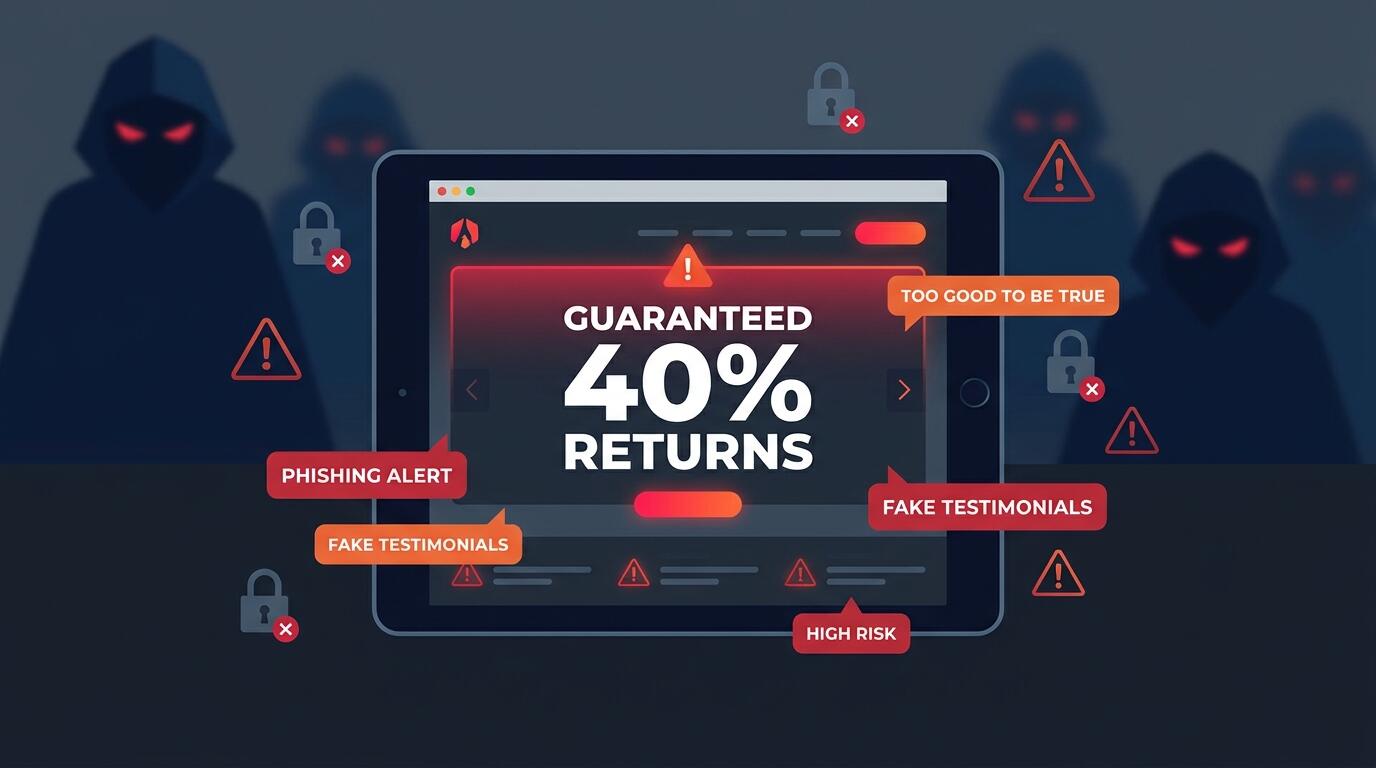
ALT: Warning signs of guaranteed return investment scams targeting online readers seeking financial security
Why "Guaranteed Returns" Online Are Almost Always Too Good to Be True
Imagine you are scrolling through your social media feed on a Tuesday afternoon when an ad stops you cold: "Earn 40% guaranteed returns — no risk, no experience needed." Maybe a friend shares a link to a platform promising that your money will double in six months, or a stranger in an investing forum insists they have a "foolproof" strategy with zero downside. These scenarios are not hypothetical — they are the everyday reality of the current online financial landscape, and they are precisely how millions of people lose real money every year.
The central finding of this article is straightforward: no legitimate financial product can genuinely guarantee a specific return, especially a high one, without exposing you to significant and often hidden risk. Understanding why that is true — and how to recognize the language patterns and structures used by those who claim otherwise — is one of the most practical pieces of financial literacy you can arm yourself with today. This topic deserves deeper analysis now because the proliferation of social media, AI-generated content, and crypto-adjacent platforms has made fraudulent "guaranteed return" pitches more sophisticated and more widespread than at any prior point in history.
The Current Landscape of Guaranteed Return Promises Online
Guaranteed return promises are not a new phenomenon, but the channels, scale, and vocabulary through which they spread have changed dramatically. What was once confined to cold-call phone scams and junk-mail flyers has migrated decisively to social media platforms, messaging apps, YouTube channels, and self-styled "fintech" websites that look polished and credible.
The Federal Trade Commission (FTC) consistently documents rising losses from investment fraud year over year, with social media identified as a primary vector for how victims first encounter fraudulent schemes. According to the FTC, investment scams are among the highest-loss fraud categories reported by consumers, and younger adults — the demographic most active on social platforms — are increasingly among those targeted and affected. These are not obscure corner-case statistics; they describe a broad, ongoing pattern that is accelerating alongside digital adoption.
Several structural shifts have made the environment particularly fertile for misleading return promises. First, historically low interest rates over much of the past decade created a genuine appetite among savers for alternatives to the minimal yields offered by traditional savings accounts. Even as Federal Reserve rate decisions have reshaped the mortgage and savings landscape, the memory of lean yield years persists — and scammers exploit the residual hunger for "better" returns. Second, the dramatic public rise of cryptocurrencies and tech-driven investment narratives created a cultural moment in which extraordinary returns seemed, to many ordinary people, not just possible but expected. Third, the barrier to publishing convincing financial content online has collapsed — sophisticated-looking websites, "testimonials," and even AI-generated endorsements can be assembled cheaply and quickly.
A pattern that consistently surfaces in our work at Vega Brief is that fraudulent platforms use the look and feel of legitimacy as a primary tool. They display logos that resemble regulatory seals, cite "proprietary algorithms," and use language drawn from real finance — all engineered to make skepticism feel uninformed rather than prudent.
ALT: Digital screen showing fake investment platform with guaranteed high returns and warning signs of online financial fraud
How the "Guaranteed Return" Mechanism Actually Works — And Why It Cannot
A genuine guarantee in finance is a legally binding commitment backed by an asset, an institution, or a government. Understanding the real meaning of the word reveals why most online "guarantees" are structurally impossible — or are deliberate misrepresentations.
What a Real Financial Guarantee Looks Like
A financial guarantee is a promise by one party (the guarantor) to cover losses or fulfill an obligation if the primary party cannot. The clearest examples in everyday finance are deposit insurance programs. In the United States, the Federal Deposit Insurance Corporation (FDIC) insures deposits at member banks up to specified limits, meaning that if a bank fails, depositors are protected to that threshold. U.S. Treasury securities are considered as close to "guaranteed" as possible for return of principal — because they are backed by the full faith and credit of the federal government. Critically, even these instruments have limits: they protect principal (the original amount) or promise a fixed coupon rate, not high, speculative, or unlimited returns.
Why High Guaranteed Returns Are a Mathematical Contradiction
If a product genuinely carries no risk, investors would flock to it in enormous numbers, and competition would quickly drive the return down toward prevailing risk-free rates — essentially what a government bond already represents. An online platform promising 30%, 50%, or 100% annual returns with no risk is claiming to have discovered something that every investment bank, university finance department, and regulatory body has failed to find despite decades of rigorous searching. That claim should, on its own, be treated with extreme skepticism.
Ponzi schemes — named after the historical fraudster Charles Ponzi — are the most common structural mechanism behind guaranteed-return frauds. A Ponzi scheme is a fraudulent investment operation where returns paid to earlier investors come not from legitimate profit but from the capital contributed by newer investors. The scheme requires a constant influx of new money to sustain the appearance of returns. When new investor flow slows or investors attempt to withdraw en masse, the structure collapses, and most participants lose what they put in. The U.S. Securities and Exchange Commission (SEC) has documented dozens of such schemes operating through online platforms, many of which explicitly advertised "guaranteed" returns.
The Role of Urgency and Exclusivity
Psychological pressure tactics are a core part of how guaranteed-return pitches work. Phrases like "limited-time offer," "only 50 spots remaining," or "exclusive group" are engineered to short-circuit the natural skepticism that would arise with time for reflection. Scammers understand that a person who pauses to verify a claim is far more likely to walk away than someone who acts immediately. In our experience reviewing how these schemes are presented to consumers, urgency language almost always appears alongside guaranteed-return promises — the two function as a package.
Platform Opacity and Regulatory Evasion
Fraudulent platforms frequently operate across jurisdictions precisely to avoid the oversight of any single financial regulator. They may claim to be registered in one country while accepting funds from citizens of another, exploiting gaps in cross-border regulatory enforcement. The SEC, the FTC, and the Commodity Futures Trading Commission (CFTC) in the United States all maintain public databases where consumers can verify whether an investment platform or advisor is registered and in good standing — but a majority of fraud victims either did not know these resources existed or did not use them before committing funds.
Crypto and "Yield" Products as Modern Vehicles
The rise of cryptocurrency and decentralized finance (DeFi) introduced a new vocabulary — "yield farming," "staking rewards," "liquidity mining" — that legitimate uses exist for, but which have also been co-opted by bad actors to dress up guaranteed-return promises in technological-sounding language. The underlying mechanism is identical: promises of extraordinary, risk-free returns that either rely on unsustainable token economics or are outright fabrications. AI-generated investment narratives about global growth trends — similar to those explored in discussions of how AI investment is shaping economic outlooks — can sound plausible enough to lend false credibility to even speculative or fraudulent platforms.
Evidence, Warning Signs, and Multiple Perspectives
The evidence that guaranteed-return promises online are dangerous is not disputed among financial regulators, academics, or consumer protection advocates. The disagreement — such as it exists — is over how aggressively platforms should be regulated and how responsibility should be distributed between platform operators, financial gatekeepers, and individual investors.
A consistent finding from regulatory enforcement actions is that victims span income levels, education levels, and age groups. Fraud is not primarily a product of financial ignorance; it is a product of sophisticated manipulation combined with opportunity. The SEC and FTC have both noted that well-educated, financially experienced individuals have lost significant sums to polished online schemes.
Several documented warning signs function as reliable indicators that a "guaranteed return" offer may be fraudulent:
The promised return is dramatically higher than current rates on comparable, verifiable products.
The investment strategy is described as "proprietary" or too complex to explain simply — complexity as a shield against scrutiny.
Pressure to recruit other investors in exchange for bonus returns (a hallmark of pyramid-adjacent structures).
Difficulty withdrawing funds or delays accompanied by new fees or conditions.
No verifiable registration with a recognized regulatory body.
Testimonials from unnamed individuals or profiles with limited verifiable history.
Perspective / Approach — Strengths — Trade-offs — Best Fit
High-return crypto/DeFi platform — Potentially high upside in legitimate cases; novel technology — Extreme volatility; frequent fraud; limited regulatory protection — Sophisticated investors who fully understand and accept total loss risk
Government-backed securities — Capital protection up to defined limits; regulatory oversight; transparent terms — Returns reflect risk-free rate — typically modest; lower growth potential — Conservative savers prioritizing capital preservation
Regulated equity index funds — Long-term growth track record; diversification; transparent cost structure — Returns are not guaranteed; market downturns affect value — Long-horizon investors comfortable with volatility
Online "guaranteed return" platform — Promises certainty and high yield simultaneously — Almost universally either fraudulent or structurally unsustainable — Not appropriate for any investor — risk of total loss
The table above illustrates a core principle: the closer a product gets to genuinely guaranteeing high returns, the higher the probability that it is either deceptive or structurally fragile. Every legitimate, high-return investment carries commensurate risk.
Where This Is Heading and What It Means for You
The environment for guaranteed-return fraud is not improving — it is evolving. Regulatory bodies including the SEC, FTC, and their counterparts in the United Kingdom (the Financial Conduct Authority) and the European Union are expanding enforcement efforts in the digital space, but the pace of scheme creation routinely outstrips the pace of action. Artificial intelligence tools now allow bad actors to generate convincing testimonials, build sophisticated-looking websites, and even deploy chatbots that simulate customer service — all at a fraction of the previous cost.
For ordinary readers, the practical implication is clear: the burden of initial skepticism falls heavily on the individual, at least until regulatory frameworks fully catch up with digital financial products. This is not a reason for despair — it is a reason to develop a specific, repeatable habit of verification.
Actionable takeaways grounded in the analysis above:
Before committing any money, verify the platform or advisor's registration using the SEC's Investment Adviser Public Disclosure database, the CFTC's registration tools, or the equivalent in your country.
Treat any promise of guaranteed returns above the prevailing risk-free rate (typically what government bonds offer) as a serious red flag requiring extraordinary evidence before engagement.
Take time deliberately — if an offer requires an immediate decision to secure your place or rate, walk away. Legitimate investment opportunities do not expire overnight.
Discuss any online investment opportunity with a trusted person who has no financial stake in your participation before committing funds.
Report suspected fraud to the appropriate regulatory body. Reporting protects not only you but others who may encounter the same scheme.
Understanding broader economic patterns helps contextualize what "reasonable" returns actually look like — which is why financial literacy across markets and institutions matters beyond any single decision.
How can I tell if an online investment promise is a scam?
The clearest red flag is a promise of high, guaranteed returns with little or no risk — this combination does not exist in legitimate finance. Other warning signs include pressure to act immediately, vague or overly technical explanations of how returns are generated, difficulty withdrawing funds, and the absence of verifiable regulatory registration. The SEC and FTC both publish free tools for checking whether an investment platform or advisor is legitimately registered before you engage.
Are any online investment returns actually guaranteed?
A small set of instruments offer meaningful principal protection — such as FDIC-insured bank deposits up to defined limits, or U.S. Treasury securities backed by the federal government. These carry modest, transparent returns that reflect their near-zero risk. Any online platform promising returns dramatically higher than government bond rates while claiming "guaranteed" status is either misusing the term, is structurally unsustainable, or is operating a fraud. No legitimate market investment guarantees both high returns and zero risk simultaneously.
How long does it typically take to discover that a guaranteed-return scheme was fraudulent?
Ponzi schemes and similar frauds can operate for months or years before collapsing, particularly if early participants receive some payments (funded by newer investors) that appear to validate the promise. Victims often do not realize the scheme has failed until they attempt to make a large withdrawal and are told funds are unavailable. Regulatory investigations can take additional time after collapse before individual cases are resolved, meaning recovery of funds — if it occurs at all — is often slow and partial.
Final Thoughts
Guaranteed return promises online are among the most consistent and well-documented forms of financial fraud in the modern consumer environment. Three core points summarize what this article has established.
First, the phrase "guaranteed return" in a financial context has a precise and narrow meaning — it applies to a small class of instruments backed by governments or regulated institutions, offering modest, transparent returns. Any online claim borrowing that language for a high-yield product is almost certainly misrepresenting reality.
Second, the mechanisms behind these schemes — Ponzi structures, psychological pressure tactics, jurisdictional evasion, and technological camouflage — are well understood and documented by regulators. Awareness of these mechanisms is itself protective.
Third, verification costs nothing. Regulatory registration databases are publicly accessible and free to use. Pausing before investing — long enough to check a registration, ask a trusted person, and compare the promised return to real-world benchmarks — is the single most effective defense available to any individual.
The recommended next step is simple: before engaging with any investment platform or offer online, spend ten minutes on the SEC's or FTC's public verification tools. That habit, applied consistently, closes the window through which most online investment fraud operates.
Want to make sense of today's financial headlines without the jargon? Visit Vega Brief for plain-English explainers on the economic news that matters most — every story is source-linked, strictly educational, and free of investment advice. Whether markets are moving or personal finance headlines are buzzing, Vega Brief helps you stay informed and financially literate with confidence.
Sources
U.S. Federal Trade Commission. "Consumer Sentinel Network Reports — Investment Fraud Data".
https://www.ftc.gov
U.S. Securities and Exchange Commission. "Investor Alerts and Bulletins — Ponzi Schemes and Online Investment Fraud".
https://www.sec.gov
U.S. Federal Deposit Insurance Corporation. "Deposit Insurance — Coverage and Limits".
https://www.fdic.gov
U.S. Commodity Futures Trading Commission. "Consumer Protection — Fraud Advisories".
https://www.cftc.gov
Financial Conduct Authority (United Kingdom). "Warning List of Unauthorized Firms and Investment Fraud Guidance".
https://www.fca.org.uk
Note: Regulatory guidance and fraud advisories are updated regularly; please check the latest official publications from relevant authorities in your jurisdiction.
For educational purposes only. Not investment advice. We do not recommend any stock, fund, broker or trading platform. Headlines are sourced from Google News · Business; every story links to the original publishers.